Owning vs. Sharing
Jun. 3rd, 2019 08:15 pm![[personal profile]](https://www.dreamwidth.org/img/silk/identity/user.png) ysabetwordsmith
ysabetwordsmithContinuing to mull over this article about lack of space, I have more thoughts about owning vs. sharing. Each has its advantages and disadvantages, mostly counterbalanced equally against each other.
* Owning is better for things you use all the time, need immediate access to, and/or plan to keep long-term. It takes more space and money, but it saves you a lot of time and trouble. There are many obvious advantages to owning a home, which most of us use a great deal.
* Sharing or renting is better for things you use occasionally, don't need immediately, or only want to use once. It saves space, money, and resources. The latter is especially important with regard to capital equipment -- compare everyone owning a lawnmower or a complete shop full of handywork tools vs. a cohousing community sharing one or two lawnmowers and a workshop. Fewer resources would be used, at a much lower cost, and more people could use the same stuff at different times. Because you're not duplicating all those purchases, you can then buy more goodies to share. That workshop probably has ten times the tools a single hobbyist could afford.
* Owning is better for things which are precious. Sharing is better when adequate quality is good enough, or when you can't afford an expensive item yourself. Take our workshop example. After trying out the tools, you might decide to buy top-notch versions of your favorites to keep at home. But you probably can't afford the nifty powered hammer everyone chipped in for, nor do you need your own of that.
* Owning is better the more rooted you are. Sharing or renting is better the more mobile you are. So long as you have free choice whether, when, and where to move either is fine. But when people get stuck somewhere they don't want to be, or forcibly torn away from home, that does a lot of harm. Bear in mind that the vast majority of local-Earth is extremely hostile to a genuine traveling lifestyle, and expects people to be settled -- or pretend to be settled for some months between moves. This is a problem in a society that increasingly forces people to move, but does not support their doing so well. That is disrupting the economy as well as lives.
* Owning is better if things make you feel happy and secure. Sharing is better if things make you feel miserable and weighed down. People who prefer to own many things need more space. People who dislike owning too much will be happier in a concise space that discourages clutter -- and gives them an excuse to turn down unwanted bulky gifts or houseguests. This is primarily a matter of personality, and it's less malleable than many other factors discussed here. Consider which way you tend to lean, and make your choices accordingly. Again, forcing people to go against their nature tends to do harm.
* Owning gives you more control over your space and what you put in it. However, if you live with anyone else, you give up some of that control just by sharing your lives. While more people live alone today, it is not very healthy for humans to do so. Living together is healthier for most people, so consider that when deciding what you wish to own.
* Sharing means you have less control. If you share with people who have similar values as yourself, most of the time you'll want the same things. This makes the quality of companionship a crucial factor in the desirability of sharing. Nobody wants to share with people they hate, but most people enjoy the company of friends and family. When people have no choice over who and what they share, it becomes a detriment instead of a boost.
* Many survival needs -- including food, water, shelter, and clothing -- relate to owning and sharing. People need secure access to all of those in reasonable quantity and quality in order to stay healthy and happy. Privacy is also a survival need, although much less recognized as such. Without it, very bad things can happen to civilization as well as personal health. Also, all organisms suffer negative consequences from overcrowding. Cramped living space causes a lot of problems. Minimum standards vary drastically, but here is one example. Note that sharing space expands the type of rooms required, not just the area. It would be better if the 6+ category required at least one more function room, as that is about where people really start needing to split up.
* Whether property is owned or rented, crowding is an essential factor. When too many people try to use the same resource at the same time, its effectiveness drops or disappears. A quiet park is relaxing; a crowded park is not. 10 people can probably share one hammer comfortably; 100 people probably cannot. Ideally, items should get regular use, but have some fault tolerance for swings in demand. Don't max out capacity on anything or every little surge in demand will cause problems. This can help you decide between owning and sharing, and how many of a thing you need.
* Owning is more secure than sharing, to the extent that your storage space is safe from theft or damage. In order to take or tamper with your things, someone must physically get into them, which is very risky behavior. Books on yourself cannot be removed or altered at the whim of a library service. Sharing is more secure than owning, if your personal space is not very safe. Things stored in the cloud cannot be lost if your junkie roommate steals your computer; you can simply access your data from a different device (even at a library, until you buy a new one). Different types of security therefore exert strong influence over people's choice between owning vs. sharing. A city without bike racks is a poor place to own a bike; one with bike racks is okay; one with bike garages is quite secure. But a citywide fleet of day-glow orange public bicycles doesn't really need garages to lock them in.
* Due to conservation of resources, sharing often means you have the use of a great deal more than you could afford to own. Take a look at this community. It has modest-sized housing units packed closely together. That leaves a lot of space for gardens, a gazebo, a community center, a playground, a badminton court, a jogging track, and so on. If they had instead divided the land equally, each would have a private yard but none of the communal amenities; even if they had a neighborhood park, it would be a considerable distance from most homes. By sharing, each person gets to use any of that common space within immediate walking distance. Because they have chosen to build very diverse facilities, this reduces the tendency of people to crowd into one spot and instead spreads them out in groups according to different interests. It also balances small private homes against expansive public features.
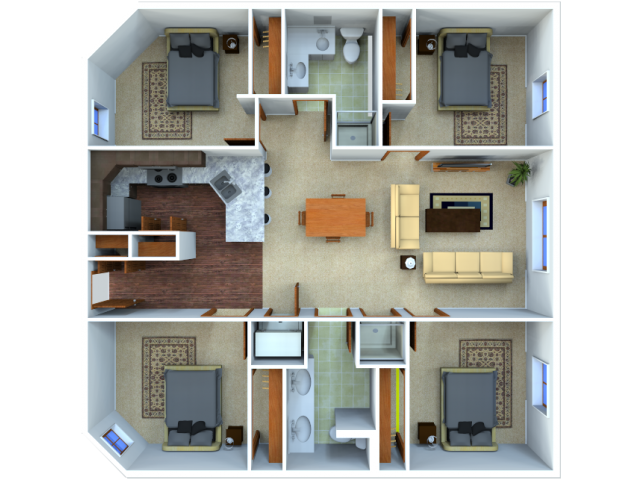
* Successful sharing relies on products designed for sharing. For example, toys and tools for school use must withstand the wear and tear of many small hands, and the same applies to a household with lots of kids. Montessori tools cost a lot more than grocery store toys because they are made from beautiful, quality materials and last for years. Now consider living space. The more people share a home, the more space they need -- not just private space, but different communal spaces too. Compare and contrast the following examples ...
This apartment is badly designed for a shared household and not much better for a family. There are two common bathrooms, so nobody has a private one, and no bathtub. All of the common space is crunched into the middle, so you have to walk around things to get anywhere and there's no way to divide activities. Even four people would feel crowded in this space, let alone more.
This apartment is perfect for 4-8 people sharing a household. Each bedroom has a private bathroom, plus a common powder room on the second floor. The ground floor includes a 2-car garage, four storage units, and a rec room for noisy activities. (That could just as easily be a music room, craft room, kids' playroom, exercise room, etc.) The second floor has a dining room, kitchen, living room, powder room, and one bedroom with ensuite and walk-in closet. The third floor has three bedrooms, each with ensuite and walk-in closet, plus a laundry room. Everyone has adequate privacy and storage space, along with enough communal space to congregate or break into smaller groups as desired. A further advantage is that the walk-in closet may be converted into some other purpose such as a kitchenette, quiet corner, office niche, or nursery.
In the first apartment, the cramped quarters offer minimal improvement over four studio apartments. But in the second, each person gets access to a LOT more space and different types of equipment compared to apartments, yet the 4-bedroom 3-story home takes up much less room than four separate houses would. So long as family members or other housemates like each other, sharing the 3-story home offers many more benefits than living alone. The cramped apartment is probably a poor trade, and unless they're extremely attached to each other, they'd probably be better off in studios. So you can see that how well sharing works will depend a lot on the context.
That means infrastructure has a huge influence on the effectiveness of owning vs. sharing -- and in local-America, what we have isn't often what we need either to buy or to share today. Much of it is out of step with consumer needs, either because it's carried over from earlier times or poorly designed because people didn't do their homework.
Choose mindfully, and consider these factors when voting on housing-related issues in your area.
* Owning is better for things you use all the time, need immediate access to, and/or plan to keep long-term. It takes more space and money, but it saves you a lot of time and trouble. There are many obvious advantages to owning a home, which most of us use a great deal.
* Sharing or renting is better for things you use occasionally, don't need immediately, or only want to use once. It saves space, money, and resources. The latter is especially important with regard to capital equipment -- compare everyone owning a lawnmower or a complete shop full of handywork tools vs. a cohousing community sharing one or two lawnmowers and a workshop. Fewer resources would be used, at a much lower cost, and more people could use the same stuff at different times. Because you're not duplicating all those purchases, you can then buy more goodies to share. That workshop probably has ten times the tools a single hobbyist could afford.
* Owning is better for things which are precious. Sharing is better when adequate quality is good enough, or when you can't afford an expensive item yourself. Take our workshop example. After trying out the tools, you might decide to buy top-notch versions of your favorites to keep at home. But you probably can't afford the nifty powered hammer everyone chipped in for, nor do you need your own of that.
* Owning is better the more rooted you are. Sharing or renting is better the more mobile you are. So long as you have free choice whether, when, and where to move either is fine. But when people get stuck somewhere they don't want to be, or forcibly torn away from home, that does a lot of harm. Bear in mind that the vast majority of local-Earth is extremely hostile to a genuine traveling lifestyle, and expects people to be settled -- or pretend to be settled for some months between moves. This is a problem in a society that increasingly forces people to move, but does not support their doing so well. That is disrupting the economy as well as lives.
* Owning is better if things make you feel happy and secure. Sharing is better if things make you feel miserable and weighed down. People who prefer to own many things need more space. People who dislike owning too much will be happier in a concise space that discourages clutter -- and gives them an excuse to turn down unwanted bulky gifts or houseguests. This is primarily a matter of personality, and it's less malleable than many other factors discussed here. Consider which way you tend to lean, and make your choices accordingly. Again, forcing people to go against their nature tends to do harm.
* Owning gives you more control over your space and what you put in it. However, if you live with anyone else, you give up some of that control just by sharing your lives. While more people live alone today, it is not very healthy for humans to do so. Living together is healthier for most people, so consider that when deciding what you wish to own.
* Sharing means you have less control. If you share with people who have similar values as yourself, most of the time you'll want the same things. This makes the quality of companionship a crucial factor in the desirability of sharing. Nobody wants to share with people they hate, but most people enjoy the company of friends and family. When people have no choice over who and what they share, it becomes a detriment instead of a boost.
* Many survival needs -- including food, water, shelter, and clothing -- relate to owning and sharing. People need secure access to all of those in reasonable quantity and quality in order to stay healthy and happy. Privacy is also a survival need, although much less recognized as such. Without it, very bad things can happen to civilization as well as personal health. Also, all organisms suffer negative consequences from overcrowding. Cramped living space causes a lot of problems. Minimum standards vary drastically, but here is one example. Note that sharing space expands the type of rooms required, not just the area. It would be better if the 6+ category required at least one more function room, as that is about where people really start needing to split up.
* Whether property is owned or rented, crowding is an essential factor. When too many people try to use the same resource at the same time, its effectiveness drops or disappears. A quiet park is relaxing; a crowded park is not. 10 people can probably share one hammer comfortably; 100 people probably cannot. Ideally, items should get regular use, but have some fault tolerance for swings in demand. Don't max out capacity on anything or every little surge in demand will cause problems. This can help you decide between owning and sharing, and how many of a thing you need.
* Owning is more secure than sharing, to the extent that your storage space is safe from theft or damage. In order to take or tamper with your things, someone must physically get into them, which is very risky behavior. Books on yourself cannot be removed or altered at the whim of a library service. Sharing is more secure than owning, if your personal space is not very safe. Things stored in the cloud cannot be lost if your junkie roommate steals your computer; you can simply access your data from a different device (even at a library, until you buy a new one). Different types of security therefore exert strong influence over people's choice between owning vs. sharing. A city without bike racks is a poor place to own a bike; one with bike racks is okay; one with bike garages is quite secure. But a citywide fleet of day-glow orange public bicycles doesn't really need garages to lock them in.
* Due to conservation of resources, sharing often means you have the use of a great deal more than you could afford to own. Take a look at this community. It has modest-sized housing units packed closely together. That leaves a lot of space for gardens, a gazebo, a community center, a playground, a badminton court, a jogging track, and so on. If they had instead divided the land equally, each would have a private yard but none of the communal amenities; even if they had a neighborhood park, it would be a considerable distance from most homes. By sharing, each person gets to use any of that common space within immediate walking distance. Because they have chosen to build very diverse facilities, this reduces the tendency of people to crowd into one spot and instead spreads them out in groups according to different interests. It also balances small private homes against expansive public features.
* Successful sharing relies on products designed for sharing. For example, toys and tools for school use must withstand the wear and tear of many small hands, and the same applies to a household with lots of kids. Montessori tools cost a lot more than grocery store toys because they are made from beautiful, quality materials and last for years. Now consider living space. The more people share a home, the more space they need -- not just private space, but different communal spaces too. Compare and contrast the following examples ...
This apartment is badly designed for a shared household and not much better for a family. There are two common bathrooms, so nobody has a private one, and no bathtub. All of the common space is crunched into the middle, so you have to walk around things to get anywhere and there's no way to divide activities. Even four people would feel crowded in this space, let alone more.
This apartment is perfect for 4-8 people sharing a household. Each bedroom has a private bathroom, plus a common powder room on the second floor. The ground floor includes a 2-car garage, four storage units, and a rec room for noisy activities. (That could just as easily be a music room, craft room, kids' playroom, exercise room, etc.) The second floor has a dining room, kitchen, living room, powder room, and one bedroom with ensuite and walk-in closet. The third floor has three bedrooms, each with ensuite and walk-in closet, plus a laundry room. Everyone has adequate privacy and storage space, along with enough communal space to congregate or break into smaller groups as desired. A further advantage is that the walk-in closet may be converted into some other purpose such as a kitchenette, quiet corner, office niche, or nursery.
In the first apartment, the cramped quarters offer minimal improvement over four studio apartments. But in the second, each person gets access to a LOT more space and different types of equipment compared to apartments, yet the 4-bedroom 3-story home takes up much less room than four separate houses would. So long as family members or other housemates like each other, sharing the 3-story home offers many more benefits than living alone. The cramped apartment is probably a poor trade, and unless they're extremely attached to each other, they'd probably be better off in studios. So you can see that how well sharing works will depend a lot on the context.
That means infrastructure has a huge influence on the effectiveness of owning vs. sharing -- and in local-America, what we have isn't often what we need either to buy or to share today. Much of it is out of step with consumer needs, either because it's carried over from earlier times or poorly designed because people didn't do their homework.
Choose mindfully, and consider these factors when voting on housing-related issues in your area.



(no subject)
Date: 2019-06-04 04:12 am (UTC)With luck, I hope to realize some version of this sort of set-up, with my extended polycule residing in both a multi-family house and a nearby large house. If this happens (and it likely eventually will), I'll advocate for sharing all rarely used items like the drill (and for that matter secondary cars that aren't being used to drive someone to work).
Thoughts
Date: 2019-06-04 04:24 am (UTC)That makes sense. Tool libraries are becoming more common. While I agree that cramped space is one reason, there are still many advantages to this approach. It's the norm in intentional communities.
>>With luck, I hope to realize some version of this sort of set-up, with my extended polycule residing in both a multi-family house and a nearby large house. If this happens (and it likely eventually will), <<
Go you!
>> I'll advocate for sharing all rarely used items like the drill (and for that matter secondary cars that aren't being used to drive someone to work).<<
Look into intentional community resources. They have tips for stuff like that, including how to assembled a fleet of vehicles. The most popular secondary, and usually the first added, is a hauler. Either a pickup truck for big or messy things, a minibus for people, or a van that can handle both. Then you can use small cars for commuting, and save a ton on gas, without sacrificing your ability to haul 8 people or a bookcase.
Re: Thoughts
Date: 2019-06-04 05:21 am (UTC)Re: Thoughts
Date: 2019-06-04 05:32 am (UTC)* Formal tool libraries work the same as book libraries. You check out a tool and bring it back. If it's trashed, you have to pay to replace it right then.
* Informal tool libraries sometimes serve only experienced crafters. This is an effective way to protect the tools, but can shut out less-experienced folks.
* Have more than one level of tool. Anyone can borrow the cheap stuff that is difficult to break, like a hammer. Borrowing more expensive, delicate tools like a jigsaw requires proving that you can use and maintain it safely. A lot of people have this rule for any kind of power tool.
* Require a membership, the fees of which go toward replacing worn-out tools or buying new ones. This strongly encourages people to maintain tools. However, it can price out poorer members of the community.
* Because lending anything works better in a high-trust environment, some communities work on building trust skills and personal virtues. It's an oblique rather than direct method, and takes time, but doesn't cost cash and has long-lasting effects.
Re: Thoughts
Date: 2019-06-04 02:28 pm (UTC)Fewer vehicles means less money and resources go to repairs and insurnce, as well as being better for the environment.
Re: Thoughts
Date: 2019-06-04 04:59 pm (UTC)As with any vehicle-related purchase, it's a good idea to test-drive samples if you can.
(no subject)
Date: 2019-06-04 08:59 am (UTC)But, if I’m at a beach, walking with a friend and not swimming, I can go when there’s not a lifeguard... and then there’s also no first-aid kit. If one of us -- or one of the dogs running along with other people — gets a cut from a quahog shell, I don’t have anything not-sandy to pack the wound with, nor a nice tourniquet that locks in place and allows me to write the time so that EMTs know when they have to take it off. Is it worth stocking my car with an expensive first-aid kit for things that MIGHT happen? Still debating this.
Thoughts
Date: 2019-06-04 05:29 pm (UTC)* First, stock for the likeliest mishaps. It is prudent to keep basics like your favorite wound wash, first aid cream, and some band-aids everywhere you go. Also include specialty items for targeted needs, e.g. a blister kit for hiking.
* Second, stock for severe problems where first aid could make a big improvement in outcome. Heavy bleeding is actually one of the easiest life-threatening injuries to stop with first aid.
* Third, consider price. You probably can't afford and won't need an AED, but if someone in your household had heart problems, you might buy one. A heavy bleeding first-aid kit starts around $20 and I've seen tourniquets alone for under $10. You can get a basic car first aid kit for under $10 and a decent one for $20. If you want something beyond impulse-purchase range, buy a basic kit first and then save up for the bigger one. You can always stash the basic one in another place (e.g. upstairs or in a guest bathroom) after upgrading.
* Fourth, consider the number of souls on board. The more people you serve as a first aider, the bigger a kit you need. (Imagine: you stumble into a patch of jellyfish or broken glass with one friend vs. six.) Cross this with above advice regarding likely needs to account for each person's common complaints. If someone has bad allergies, you may need to diversify on antihistamines.
* Fifth, stock with your training in mind. You don't need things that you don't know how to use. But it's a good idea to have what you can use if there's a reasonable chance you may need it. This is why medics often carry a heavy-duty kit in their car. If the vehicle ahead of them wrecks, they want to stop and help, without having to wait for an ambulance to show up with real supplies.
I couldn't find a good beach first aid kit, but you can assemble your own. By the way, you can borrow a trick from T-America here: sticky labels let you write on them clearly and will adhere to skin or clothing, rather than trying to write with pen that may not show up (black pen on dark brown skin) or upset people. Just make sure you get the kind with strong adhesive.
Re: Thoughts
Date: 2019-06-05 09:23 am (UTC)Thank you for the link to less-expensive versions.
Re: Thoughts
Date: 2019-06-05 10:04 am (UTC)https://www.buyemp.com/category/cpr-pocket-masks
(no subject)
Date: 2019-06-04 10:15 pm (UTC)Granted, said "car" was a VW camper, so there was room, AND the "kit" was basically a smallish *suitcase*, and prepped for anything that didn't need licensed medical professionals, special tech, or prescription medications...
If I had less stress in my life, I'd likely do the same, even if I don't go too many places these days, just because you never know when something might be needed. But then I'm that sort of person that makes sure I have a canner that does a reliable pressure of 15 PSI... :)
(no subject)
Date: 2019-06-04 01:48 pm (UTC)One quick thing: the *bad* examples are better than what an employed, college-educated, privileged person with family backing can afford as an individual, couple, or group of adults in Portland, OR...
Which is not to disagree at all with what you've noted as the issues of the spaces. Sigh.
Thoughts
Date: 2019-06-04 05:34 pm (UTC)Painfully true, and in fact, true in many places in L-America. So then, we see problems congruent with overcrowding: anxiety, depression, suicide, domestic violence, a truly epic opioid epidemic, and so on.
T-America has a better society in part because they:
* pay a living wage
* build better residences
* teach people communal skills.
Each of those is a separate activism goal in L-America.
What I have seen in Portland that you could support? Infills and pocket neighborhoods. Some of these are extremely well designed, and make use of concise living space with shared amenities to create lovely places to live. A different manifestation of the same principles is a high-rise apartment building with one or more amenity floors and self-contained parking. Watch your town hall and polling place for opportunities to address the overcrowding issues.
(no subject)
Date: 2019-06-04 02:21 pm (UTC)We collect books on religion and stuff mostly because we want to have our own library someday that we can lend books to people who are interested in a particular path, or herbology or studying Crystals or whatever.