![[personal profile]](https://www.dreamwidth.org/img/silk/identity/user.png) ysabetwordsmith
ysabetwordsmithThese are the content notes for "No Faster or Firmer Friendships."
"There are no faster or firmer friendships than those formed between people who love the same books."
-- Irving Stone, Clarence Darrow for the Defense
"A Hint of the Resurrection"
Story Date: Wednesday, June 3, 2015
Summary: Aidan finds out about Saraphina's cousin Josué.
M-FYN is one of several programs designed to identify survivors immediately after a disaster and help them contact friends or family. Registered members can log in from any device to record their status. The original release just offered "I'm fine" but quickly expanded to "I need assistance," "I'm fine," and "I can help." Later upgrades added more options such as "In care," "Missing," and "Confirmed dead." Those account not just for personal updates but also official ones. After logging their basic status, members can add details like their current location and anything they need (e.g. a place to stay, clothes, emergency funds). Members can also link accounts to friends and family in the network, to receive notifications of safety or need after an incident. An array of Mute tools can be set in different ways to account for mass-casualty events, such as turning off alerts about nearby members to avoid getting deluged with messages, or turning them down to just immediate family. The original acronym stands for Massacre-Find Your Name, and is pronounced "I'm fine."
Microfyne is a relatively new "very smart" material retro-engineered from gizmology, foomp, which was itself derived from the super-gizmotronic ArgoFoam. Microfyne was actually intended as a shock-absorbing insulation to cushion impact, switching from the expensive argon-activated foam structure to microfibers. But the inventor's cat kept stealing his samples to make a nest, and then his daughter would steal them from the cat. When asked, she explained, "It's all warm and fuzzy, and it makes me feel safe." Further investigation revealed unique thermal retention properties, in that it stores heat as well as insulating against heat loss, while responding to changes in body temperature to prevent overheating. It is thermotaxic, buffering toward standard human body temperature, so that it fluffs in response to lower temperatures and flattens at higher ones. Microfyne also provides a subtle yet definite boost to emotional state, higher than that from other materials used in comfort objects. Not many people have noticed yet, but it's resistant to many superpowers; some may get through the holes, but the material itself usually can't be affected. Microfyne retains the hypoallergenic nature of the original gizmology but is cheaper to produce, so has recently been released to emergency services for shock blankets. It is still under patent protection, as the composition differs enough from ArgoFoam and foomp.
A subsequent application is for comfort objects used in EFA, followed by introducing those and the blankets to the prison system in hopes of connecting with inmates.
Spanish Books
11 Book Celebrate Diversity Set - Spanish/English (1 Teacher's Guide, 10 Multicultural Books, Lesson Plans, Diversity Activities)
This set provides the tools that teachers and homeschooling parents need to celebrate diversity in the classroom and at home.
The set includes: 10 Spanish/English Bilingual Books for students and one copy of Building Bridges With Bilingual Books And Multicultural Resources (an English-only teacher resource guide). You may also choose to add the PENpal Audio Recorder Pen at a discounted rate.
10 picture books pair with the multicultural lesson plans and diversity activities contained in the Building Bridges With Bilingual Books And Multicultural Resources teacher guide. In addition to the detailed lesson plans, the guide provides numerous diversity activities, literacy games, and fun activities from around the world.
The Spanish/English bilingual books in this set are: Welcome To The World Baby, The Wibbly Wobbly Tooth, Mei Ling's Hiccups, The Giant Turnip, The Children of Lir, Yeh-Hsien A Chinese Cinderella, Li's Chinese New Year, Samira's Eid (English Only), Deepak's Diwali (English Only), and Marek and Alice's Christmas.
This unique and valuable set will give you the tools to:
• Build culturally responsive classrooms
• Create positive connections with dual language children & families
• Teach children about other languages & cultures
• Support literacy development among English language learners
Foster a welcoming and inclusive learning environment.
The Giant Turnip (Bilingual Multicultural Book) - Spanish/English
Author: Henriette Barkow
Illustrator: Richard Johnson
This story tells the traditional tale of children at an inner-city school who have managed to grow an enormous turnip! They are amazed, but how will they pull it out of the ground? No matter how hard they try, the turnip just won't budge! It's left to Larry to save the day...
This is a fun multicultural story that can be used to encourage community and cooperation.
THIS TITLE IS AVAILABLE IN MANY BILINGUAL EDITIONS.
Canned vs Dried Beans: Which is Better?
The Last Calabash: A Guide to Surviving Genocide and Other Family Loss is a Terramagne-Burundi series created by a Tutsi woman (the author, Amahoro Makenga) and her Hutu husband (the artist, Mazimpaka Bizimana), both sole survivors from acts of genocide. The series offers four levels for preschool children, school-age children, teens, and adults.
The storybook The Last Calabash: A Tale of Survival tells how Amahoro came home one day to find her whole Tutsi family killed by Hutu raiders, who had also burned down the house and destroyed the field except for one ripe calabash gourd under her mother's body. Amahoro buried her family, saved the seeds from the calabash, and walked away. Eventually she wound up in an aid station where she joined a support group for survivors. There she met Mazimpaka, a Hutu boy who lost his whole family in a retaliatory raid by Tutsis. As they worked through their anger and grief, they realized that they had the same life goals: to repopulate their families as much as possible, and to help other survivors recover so as to reduce the chance of future genocides. Thus they fell in love and got married. In the garden of their new home, they planted the calabash seeds and grew what they called Peace Gourds.
The workbook The Last Calabash: A Workbook for Survivors of Genocide and Other Family Loss is available in preprinted or printable formats. It includes many exercises that guide survivors through remembering what happened to them, placing it in the context of the past as part of their life story, then creating meaning and joy in their new life. It promotes awareness of post-traumatic stress and complicated grief with coping skills for both.
The storybooks and workbooks both include author and artist biography summaries explaining how Amahoro Makenga has become a famous genocide scholar and counselor, while Mazimpaka Bizimana has become a renowned peaceworker and mediator, plus a list of their children current to the publication date (updated yearly). Underneath that is the traditional wedding quote, "In the heart of Burundi, we sip from one calabash, not just a drink, but a symbol of unity, peace, and a bond that goes beyond words." The Last Calabash series is available in many languages.
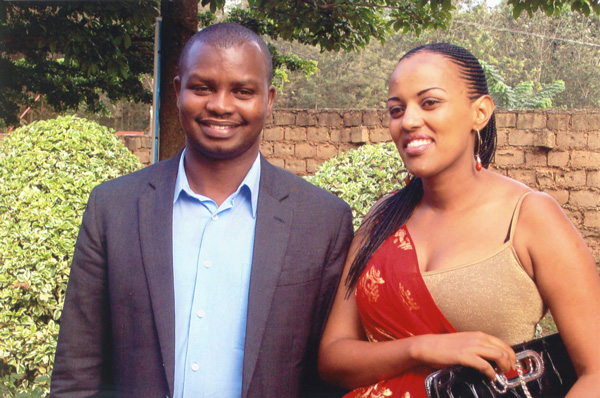
Mazimpaka Bizimana man and Amahoro Makenga woman
"In the heart of Burundi, we sip from one calabash, not just a drink, but a symbol of unity, peace, and a bond that goes beyond words."
-- Traditional Saying
Calabash is a vine which is grown for its fruit. It belongs to the family Cucurbitaceae, is native to tropical Africa, and cultivated across the tropics. It can be either harvested young to be consumed as a vegetable, or harvested mature to be dried and used as a kitchen utensil (typically as a ladle or bowl), beverage container or a musical instrument. When it is fresh, the fruit has a light green smooth skin and white flesh.
Mass killings of Tutsis were conducted by the majority-Hutu populace in Burundi from 21 October to December 1993, under an eruption of ethnic animosity and riots following the assassination of Burundian President Melchior Ndadaye in an attempted coup d'état. The massacres took place in all provinces apart from Makamba and Bururi, and were primarily undertaken by Hutu peasants. At many points throughout, Tutsis took vengeance and initiated massacres in response.
The United Nations Population Fund and the Government of Burundi conducted study in 2002 which concluded that a total of 116,059 people died during the events. The question of whether the killings of Tutsis arose from a planned genocide or from spontaneous violence remains heavily disputed among academics and Burundians who lived through the events.
23 years ago in 2016
Amahoro was 15 in 1993 and is 38 in 2016.
Mazimpaka was 16 in 1993 and is 39 in 2016.
They met at a survivor support group in 1994 and married in 1995; they have been together for 21 years.
They have 11 children (the youngest two fraternal twins) and Amahoro is pregnant again in 2016. They have 2 grandchildren from their oldest daughter.
These are some exercises from the workbook:
What is the earliest memory you can recall? Is it happy or sad, or something else? What is a significant memory that happened to you recently? How do you feel about that one? It is natural to move through different feelings over time, or you may have mixed feelings about the same event. However you feel is fine.
Begin to create a timeline of your life story. Use string, tape, words, newspaper clippings, drawings, or whatever you choose. Add to this as you work through what has happened to you.
What happened when your family died? How will you remember them (telling stories, making pictures, etc.) now?
What strengths have you discovered in yourself that you never knew you possessed until you needed them? How can you use these as you build your future?
Draw a picture or make a collage showing a place you have loved and lost. Do another for a place you love now, or imagine one if you haven't found one yet. Place them side by side as stepping stones from your past and present or future.
What is something that broke in you when your family died, or when some other horrible thing happened to you? What can you do to help this part heal?
What is a beautiful thing you remember from your home when your family was alive? What is a new beautiful thing you can bring into your current life?
baby = tibebe
-- Haitian Creole-English Dictionary
Sequin flag art is a traditional Haitian art form that uses colorful sequins to create beautiful and intricate designs. This art form has a long history in Haiti and is believed to have originated with the Maroons, a group of escaped enslaved people who lived in the mountains of Haiti.
"The Chaos"
Dearest creature in creation
Studying English pronunciation,
I will teach you in my verse
Sounds like corpse, corps, horse and worse.
-- Gerard Nolst Trenité (1922)
SQUIRREL MONKEY (BILINGUAL CHILDREN'S BOOK) - SPANISH-ENGLISH
1Review
Squirrel Monkey - Bilingual Children's Book in Spanish, Chinese, Arabic, French, Dari, Pashto and many other languages.
A thoughtful tale about acceptance and the power of mindfulness.
Squirrel Monkey (Bilingual Children's Book) - Spanish/English
Author: Elizabeth Álvarez Alfaro
Illustrator: Jesús Gabán
Set in the rainforest of Latin America, Squirrel Monkey is a thoughtful tale about acceptance and the power of mindfulness. Cori, the playful squirrel monkey, is sometimes overwhelmed by his “big feelings,” especially when the noisy bustle of the jungle gets to be too much for the little monkey. While the other animals struggle to soothe Cori’s distress, his mother demonstrates the power of slow meditative breathing to balance emotions and help Cori find a place of “calm and quiet” in the busy jungle.
Squirrel Monkey comes with downloadable worksheets that can be used by parents and educators. To see all lesson plans and other teacher resources for products available from Language Lizard, click here.
THIS TITLE IS AVAILABLE IN MANY BILINGUAL EDITIONS.
"There are no faster or firmer friendships than those formed between people who love the same books."
-- Irving Stone, Clarence Darrow for the Defense
"A Hint of the Resurrection"
Story Date: Wednesday, June 3, 2015
Summary: Aidan finds out about Saraphina's cousin Josué.
M-FYN is one of several programs designed to identify survivors immediately after a disaster and help them contact friends or family. Registered members can log in from any device to record their status. The original release just offered "I'm fine" but quickly expanded to "I need assistance," "I'm fine," and "I can help." Later upgrades added more options such as "In care," "Missing," and "Confirmed dead." Those account not just for personal updates but also official ones. After logging their basic status, members can add details like their current location and anything they need (e.g. a place to stay, clothes, emergency funds). Members can also link accounts to friends and family in the network, to receive notifications of safety or need after an incident. An array of Mute tools can be set in different ways to account for mass-casualty events, such as turning off alerts about nearby members to avoid getting deluged with messages, or turning them down to just immediate family. The original acronym stands for Massacre-Find Your Name, and is pronounced "I'm fine."
Microfyne is a relatively new "very smart" material retro-engineered from gizmology, foomp, which was itself derived from the super-gizmotronic ArgoFoam. Microfyne was actually intended as a shock-absorbing insulation to cushion impact, switching from the expensive argon-activated foam structure to microfibers. But the inventor's cat kept stealing his samples to make a nest, and then his daughter would steal them from the cat. When asked, she explained, "It's all warm and fuzzy, and it makes me feel safe." Further investigation revealed unique thermal retention properties, in that it stores heat as well as insulating against heat loss, while responding to changes in body temperature to prevent overheating. It is thermotaxic, buffering toward standard human body temperature, so that it fluffs in response to lower temperatures and flattens at higher ones. Microfyne also provides a subtle yet definite boost to emotional state, higher than that from other materials used in comfort objects. Not many people have noticed yet, but it's resistant to many superpowers; some may get through the holes, but the material itself usually can't be affected. Microfyne retains the hypoallergenic nature of the original gizmology but is cheaper to produce, so has recently been released to emergency services for shock blankets. It is still under patent protection, as the composition differs enough from ArgoFoam and foomp.
A subsequent application is for comfort objects used in EFA, followed by introducing those and the blankets to the prison system in hopes of connecting with inmates.
Spanish Books
11 Book Celebrate Diversity Set - Spanish/English (1 Teacher's Guide, 10 Multicultural Books, Lesson Plans, Diversity Activities)
This set provides the tools that teachers and homeschooling parents need to celebrate diversity in the classroom and at home.
The set includes: 10 Spanish/English Bilingual Books for students and one copy of Building Bridges With Bilingual Books And Multicultural Resources (an English-only teacher resource guide). You may also choose to add the PENpal Audio Recorder Pen at a discounted rate.
10 picture books pair with the multicultural lesson plans and diversity activities contained in the Building Bridges With Bilingual Books And Multicultural Resources teacher guide. In addition to the detailed lesson plans, the guide provides numerous diversity activities, literacy games, and fun activities from around the world.
The Spanish/English bilingual books in this set are: Welcome To The World Baby, The Wibbly Wobbly Tooth, Mei Ling's Hiccups, The Giant Turnip, The Children of Lir, Yeh-Hsien A Chinese Cinderella, Li's Chinese New Year, Samira's Eid (English Only), Deepak's Diwali (English Only), and Marek and Alice's Christmas.
This unique and valuable set will give you the tools to:
• Build culturally responsive classrooms
• Create positive connections with dual language children & families
• Teach children about other languages & cultures
• Support literacy development among English language learners
Foster a welcoming and inclusive learning environment.
The Giant Turnip (Bilingual Multicultural Book) - Spanish/English
Author: Henriette Barkow
Illustrator: Richard Johnson
This story tells the traditional tale of children at an inner-city school who have managed to grow an enormous turnip! They are amazed, but how will they pull it out of the ground? No matter how hard they try, the turnip just won't budge! It's left to Larry to save the day...
This is a fun multicultural story that can be used to encourage community and cooperation.
THIS TITLE IS AVAILABLE IN MANY BILINGUAL EDITIONS.
Canned vs Dried Beans: Which is Better?
The Last Calabash: A Guide to Surviving Genocide and Other Family Loss is a Terramagne-Burundi series created by a Tutsi woman (the author, Amahoro Makenga) and her Hutu husband (the artist, Mazimpaka Bizimana), both sole survivors from acts of genocide. The series offers four levels for preschool children, school-age children, teens, and adults.
The storybook The Last Calabash: A Tale of Survival tells how Amahoro came home one day to find her whole Tutsi family killed by Hutu raiders, who had also burned down the house and destroyed the field except for one ripe calabash gourd under her mother's body. Amahoro buried her family, saved the seeds from the calabash, and walked away. Eventually she wound up in an aid station where she joined a support group for survivors. There she met Mazimpaka, a Hutu boy who lost his whole family in a retaliatory raid by Tutsis. As they worked through their anger and grief, they realized that they had the same life goals: to repopulate their families as much as possible, and to help other survivors recover so as to reduce the chance of future genocides. Thus they fell in love and got married. In the garden of their new home, they planted the calabash seeds and grew what they called Peace Gourds.
The workbook The Last Calabash: A Workbook for Survivors of Genocide and Other Family Loss is available in preprinted or printable formats. It includes many exercises that guide survivors through remembering what happened to them, placing it in the context of the past as part of their life story, then creating meaning and joy in their new life. It promotes awareness of post-traumatic stress and complicated grief with coping skills for both.
The storybooks and workbooks both include author and artist biography summaries explaining how Amahoro Makenga has become a famous genocide scholar and counselor, while Mazimpaka Bizimana has become a renowned peaceworker and mediator, plus a list of their children current to the publication date (updated yearly). Underneath that is the traditional wedding quote, "In the heart of Burundi, we sip from one calabash, not just a drink, but a symbol of unity, peace, and a bond that goes beyond words." The Last Calabash series is available in many languages.
Mazimpaka Bizimana man and Amahoro Makenga woman
"In the heart of Burundi, we sip from one calabash, not just a drink, but a symbol of unity, peace, and a bond that goes beyond words."
-- Traditional Saying
Calabash is a vine which is grown for its fruit. It belongs to the family Cucurbitaceae, is native to tropical Africa, and cultivated across the tropics. It can be either harvested young to be consumed as a vegetable, or harvested mature to be dried and used as a kitchen utensil (typically as a ladle or bowl), beverage container or a musical instrument. When it is fresh, the fruit has a light green smooth skin and white flesh.
Mass killings of Tutsis were conducted by the majority-Hutu populace in Burundi from 21 October to December 1993, under an eruption of ethnic animosity and riots following the assassination of Burundian President Melchior Ndadaye in an attempted coup d'état. The massacres took place in all provinces apart from Makamba and Bururi, and were primarily undertaken by Hutu peasants. At many points throughout, Tutsis took vengeance and initiated massacres in response.
The United Nations Population Fund and the Government of Burundi conducted study in 2002 which concluded that a total of 116,059 people died during the events. The question of whether the killings of Tutsis arose from a planned genocide or from spontaneous violence remains heavily disputed among academics and Burundians who lived through the events.
23 years ago in 2016
Amahoro was 15 in 1993 and is 38 in 2016.
Mazimpaka was 16 in 1993 and is 39 in 2016.
They met at a survivor support group in 1994 and married in 1995; they have been together for 21 years.
They have 11 children (the youngest two fraternal twins) and Amahoro is pregnant again in 2016. They have 2 grandchildren from their oldest daughter.
These are some exercises from the workbook:
What is the earliest memory you can recall? Is it happy or sad, or something else? What is a significant memory that happened to you recently? How do you feel about that one? It is natural to move through different feelings over time, or you may have mixed feelings about the same event. However you feel is fine.
Begin to create a timeline of your life story. Use string, tape, words, newspaper clippings, drawings, or whatever you choose. Add to this as you work through what has happened to you.
What happened when your family died? How will you remember them (telling stories, making pictures, etc.) now?
What strengths have you discovered in yourself that you never knew you possessed until you needed them? How can you use these as you build your future?
Draw a picture or make a collage showing a place you have loved and lost. Do another for a place you love now, or imagine one if you haven't found one yet. Place them side by side as stepping stones from your past and present or future.
What is something that broke in you when your family died, or when some other horrible thing happened to you? What can you do to help this part heal?
What is a beautiful thing you remember from your home when your family was alive? What is a new beautiful thing you can bring into your current life?
baby = tibebe
-- Haitian Creole-English Dictionary
Sequin flag art is a traditional Haitian art form that uses colorful sequins to create beautiful and intricate designs. This art form has a long history in Haiti and is believed to have originated with the Maroons, a group of escaped enslaved people who lived in the mountains of Haiti.
"The Chaos"
Dearest creature in creation
Studying English pronunciation,
I will teach you in my verse
Sounds like corpse, corps, horse and worse.
-- Gerard Nolst Trenité (1922)
SQUIRREL MONKEY (BILINGUAL CHILDREN'S BOOK) - SPANISH-ENGLISH
1Review
Squirrel Monkey - Bilingual Children's Book in Spanish, Chinese, Arabic, French, Dari, Pashto and many other languages.
A thoughtful tale about acceptance and the power of mindfulness.
Squirrel Monkey (Bilingual Children's Book) - Spanish/English
Author: Elizabeth Álvarez Alfaro
Illustrator: Jesús Gabán
Set in the rainforest of Latin America, Squirrel Monkey is a thoughtful tale about acceptance and the power of mindfulness. Cori, the playful squirrel monkey, is sometimes overwhelmed by his “big feelings,” especially when the noisy bustle of the jungle gets to be too much for the little monkey. While the other animals struggle to soothe Cori’s distress, his mother demonstrates the power of slow meditative breathing to balance emotions and help Cori find a place of “calm and quiet” in the busy jungle.
Squirrel Monkey comes with downloadable worksheets that can be used by parents and educators. To see all lesson plans and other teacher resources for products available from Language Lizard, click here.
THIS TITLE IS AVAILABLE IN MANY BILINGUAL EDITIONS.