![[personal profile]](https://www.dreamwidth.org/img/silk/identity/user.png) ysabetwordsmith
ysabetwordsmithThese are the content notes for "The Most Dangerous Animal in the Zoo."
Just beyond the ticket booth Father had painted on a wall in bright red letters the question: DO YOU KNOW WHICH IS THE MOST DANGEROUS ANIMAL IN THE ZOO? An arrow pointed to a small curtain. There were so many eager, curious hands that pulled at the curtain that we had to replace it regularly. Behind it was a mirror.
-- Yann Martel
Zoo: An excellent place to study the habits of human beings.
-- Evan Esar
Roadside zoos are largely unregulated in Terramagne-America. Some states, especially in the east, have their own regulations, but the western and northern areas mostly don't. It follows the pattern of population: more rural or wilderness areas are much more tolerant of animals and animal handling, whereas more urban areas want it banned or restricted to approved professionals. So there's much more flexibility and diversity. This sometimes causes problems, but there are concrete reasons for it.
* Right To Work. In Terramagne-America this literally means people have the freedom to work and impairing that freedom or charging money for it is generally considered wrong. (It has a different, worse meaning in Local-America which is irrelevant here.) Lawsuits proved that closing roadside attractions, including zoos, consistently had a negative effect on local economies, more so in already job-poor areas where such facilities tend to exist.
Also relevant to this point were lawsuits in which Very Special People successfully defended their right to work as entertainers -- including at freak shows, sideshows, or roadside zoos -- which enabled them to support themselves rather than becoming charity cases since many of them had traits which made more conventional jobs difficult or impossible. This is vitally important because T-America is not fully integrated and soups often struggle to find work, even though a handful of abilities are highly prized. "Show soup" is just a modern iteration of the many performance or exhibition based jobs that people with different appearances or abilities have taken in the past. It's one reason why both roadside attractions and carnivals have remained more popular in T-America than here. Arguments over "dignity" are best left to the Very Special People and soups themselves. A common argument: "People are going to stare. At least this way, they gotta pay me."
* Classism and racism. Roadside zoos tend to be cheaper and more accessible than big fancy zoos, so closing them had a direct negative impact on the ability of poor people and people of color to enjoy zoos at all. This type of impact is prohibited after the Civil Rights Act, and does not have to be a goal of the activity charged; it is enough merely to prove that it has a disproportionate and negative effect on people of color in order for it to be disallowed as racist.
* Home for animal oddities. A subset of sideshow, this focuses on animals (often domestic, occasionally wild or exotic) with more or fewer heads, eyes, legs, or other features; exceptional size, weight, or color; and other variations. Curios or curiosities include many of the same things, just dead and preserved. Live ones require care which costs money. As few people want such animals, they are often destroyed. The animal oddities show improves their chances of survival. More recently, some veterinarians have used it to showcase adaptive equipment for disabled animals such as prosthetic limbs or wheeled carts. They figure if people have seen it before, they're more likely to choose rehabilitation over euthanasia should their own pet need such a decision.
* Value of diversity. When people are free to try many different things, then it is easier for providers and customers to find things they like. Also, problems are much more likely to be solved with many people trying diverse solutions than few people trying limited approaches. This is critically important with things like reproduction programs where someone may stumble across an obscure method that works, based on personal skills or uncommon local features. The value of diversity is an established good in T-America.
* What makes people human. One telling argument from a university said that it was hazardous to block things that led to human development and civilization.
Worth noting is that in Terramagne, some of the "thalidomide babies" became carneys at a very young age in the 1950s-1960s as carnival owners approached parents with the idea of show business as a viable career for their children. Several carnivals cultivated troupes of a dozen or more, which happily allowed the children to form healthy communities with their peers. The largest, Selkie Village, had just over four dozen. Many of these children grew up to marry others from their own or another such troupe (or in some cases, other carneys). In subsequent generations, some seal primals began to appear -- and in at least a few families of Irish or Scottish descent, actual selkies. Some other thalidomide babies went to work in sideshows at roadside attractions. More recently, defects such as phocomelia and amelia have come from herbicide exposure; and again, show business has absorbed a number of these affected individuals.
Stanislaus Berent was born in Pittsburgh, Pennsylvania, on November 24, 1901. ‘Stanley’s’ stunted arms, a condition known as phocomelia, were due to a genetic fault and likely not due to chemical exposure. Phocomelia is a common defect associated with exposure to the drug thalidomide. Over 10,000 children were born with severe malformations due to prescription of the drug during the 50’s and 60’s.
[---8<---]
In 1972 Ward Hall’s show came under attack from a political correctness group who believed the workers were being exploited. An obscure 1921 Florida law that banned the exhibition of the ‘handicapped’ was cited. Sealo, Ward Hall and a band of performers sued the State of Florida and the law was eventually repealed.
Some places became known for the Very Special People living there, like Gibtown, Florida which was a carney town. Multiple "tiny towns" -- often called Midgetville or similar, and more often a street or neighborhood than a whole town -- have sprung up to house Little People for the simple reason that it's a lot easier to build to size when they are together than scattered, much like Deaf architecture. Founded by carneys, these towns have set their ordinance to require accommodation of physical differences (far ahead of the Civil Rights Act of 1964 or the Americans with Disabilities Act of 1990) and to allow many things (e.g. fire-eating, sharpshooting, exotic animals) that other areas often banned. Certain show hosts, like Ward Hall in Gibtown, excelled at finding ways to frame physical differences as entertainment or even superpowers, assisting Very Special People in crafting characters and acts that were professionally interesting, crowd-pleasing, and thus lucrative. Because many circus and carnival shows have combined human and animal entertainments, this encouraged their connection. Thus many roadside attractions, which drew inspiration from those roots, also include a similar combination of elements on a smaller scale.
This article points out some major advantages of roadside zoos and issues without their opposition. 1) Classism. Roadside zoos tend to be cheap, plentiful, and readily accessible to many people. This is because they are smaller and don't have the high overhead of accredited facilities. Not everyone can go to a big, fancy, expensive zoo where the entry price and food cost more than the minimum wage hourly rate (which is $15 in T-America). Condemning and seeking to ban roadside zoos therefore has much more impact on the poor and people of color.
This roadside zebra exhibit is inferior. Exhibiting animals in small barren stalls or cages is inhumane. However, this is how city zoos started too. They've just had more money to outgrow it. Some roadside or other zoos have, others haven't.
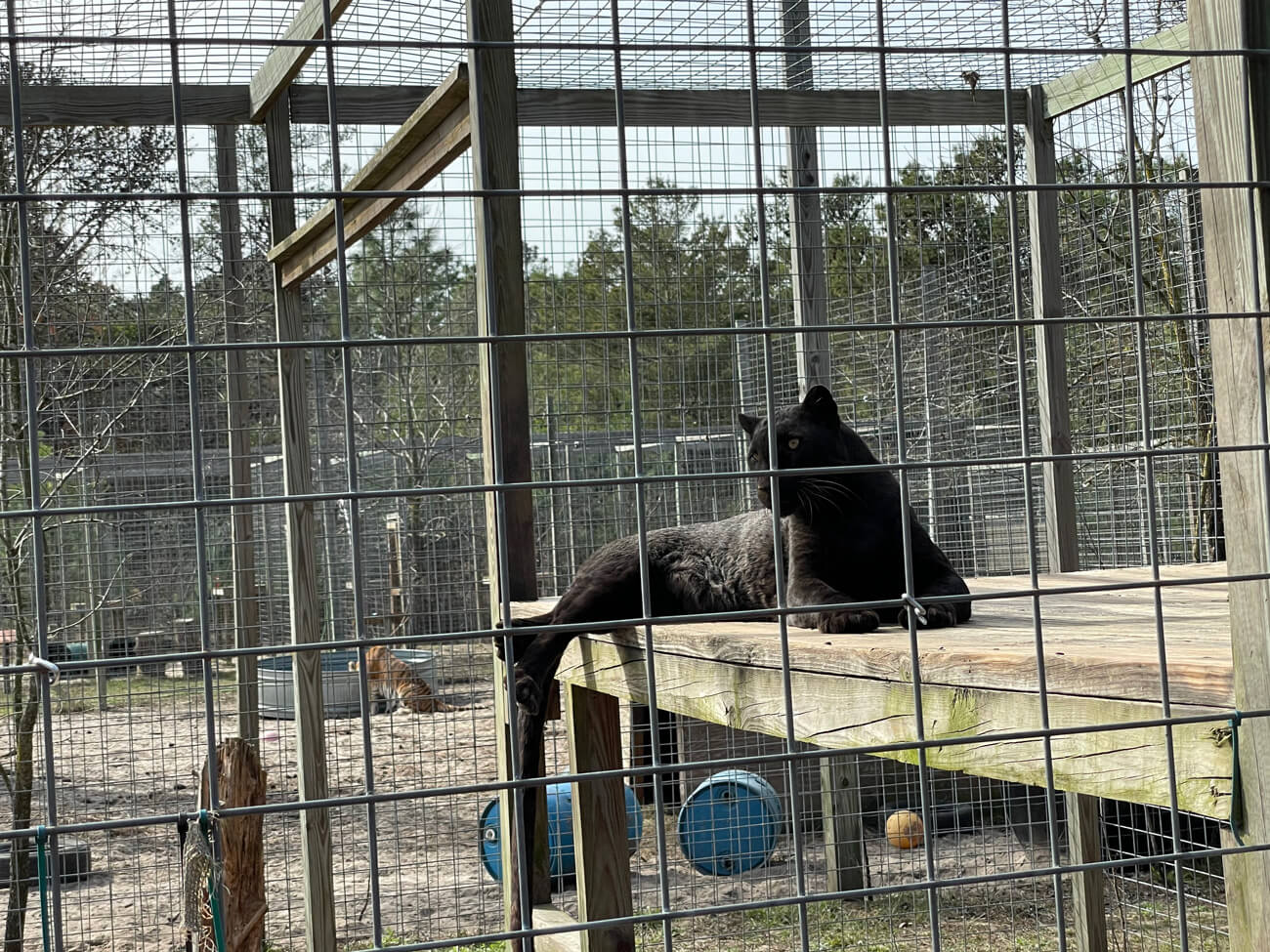
This roadside jaguar exhibit is marginal. It includes a climbing platform, shelter, and some toys but is really too small for a jaguar and not very stimulating -- unless live prey is released, which is a lot more common in T-America than here. The tigers in the background have a bigger space with a soaking pool, but again, too small for their size.
This roadside lemur exhibit looks pretty much the same as one at a city zoo: a legible sign, a troop of lemurs in a space suited to their size with lots of things to climb and privacy shelters in different locations. Things like this are why a modest, responsible roadside or small-town zoo can outperform a larger but more careless city zoo overreaching its budget.
Of course, because this is Terramagne, they have more options than here. This pachycephalosaurus lives in a large grassy paddock. While most states have sensibly banned giant, carnivorous, or otherwise dangerous dinosaurs there are more states that allow "living art exhibits" of smaller, herbivorous, and otherwise less hazarous ones. Also in this category are variations on domestic animals like unicorns or pegasi. Some people complain about these exhibits regardless of the actual conditions, just like they complain about fish in art glass aquaria.
Many people argue that zoos, especially accredited facilities, improve the lives of animals and preserve endangered species that may become extinct in the wild. Zoos also provide a crucial human-animal connection, without which few modern people would have opportunities to bond with nature. What people don't know, they don't love; and what they don't love, they don't protect. Television doesn't count because it doesn't provide the same personal contact; it evokes interest but rarely awe, and film remains even if the animals go extinct. Some zoos, like the St. Louis Zoo, have pioneered groundbreaking advances in habitat replication, enrichment programs, and captive breeding. Explore the advantages and disadvantages of zoos.
Some of the best roadside zoos, and a key reason for their survival in Terramagne-America, don't display exotic species but rather those from the local or state ecosystem(s). Another high-performing branch displays a small, curated collection of species from a "sister town" in a very different ecoregion, which may be elsewhere in America or in another country.
A different iteration has arisen with the development of electric cars, which take considerably longer to charge than filling a gas tank. T-America has dealt with this by installing some of its chargers at rest areas, restaurants, laundromats, and other places that already naturally offer something to do for half an hour. Custom-built charging stations, however, tend to include multiple options including showers, laundry, food, exercise areas -- and roadside attractions. T-Tesla ran a study on what people like most about zoos. Among the features they identified were animals with interesting habits, animals that sit still for sketching, and people wishing they could climb on the cool exhibits. So the developers have designed active exhibits like glass-walled beehives or prairie dog towns, passive exhibits like ball pythons or turtles, and playground equipment that resembles zoo exhibit climbing structures. T-Tesla and several other donors helped to launch the independent organization Responsible Roadside Attractions, which now certifies a wide range of human, animal, equipment, and service options for safety and suitability.
Petting zoos feature animals that people can touch and interact with. T-America favors domestic over wild or exotic animals for these, although sometimes the latter also appear. More often there is another exhibit of exotic animal teeth, bones, feathers, hides, etc. for people to touch. In urban areas, common livestock such as sheep and rabbits may suffice. In rural areas, rarer livestock such as llamas or ostriches will be needed to attract attention. Petting zoos often include options like a pony ride or hay ride. T-America favors educational experiences like "Learn to Milk a Goat" or "Learn to Drive a Pony Cart" that not only teach useful skills but may encourage children to consider careers working with animals. Petting zoos are commonly used to advertise farm products or other handicrafts; they are quite popular at orchards or other U-Pick farms.
More controversial is that some people with animal traits (or human quirks that resemble animal traits) have capitalized on the audience's desire to touch by offering that for a fee. Despite occasional complaints, it is no more undiginifed than the kind of "Spank a beggar for a quarter" gig seen at some Renaissance Faires or dunking booths at county fairs. So, primal soups sometimes appear in petting zoos, and a roadside zoo with that service may be called a petting zoo whether or not it has anything else to pet.
The highest population of ligers is in the USA (legal loopholes in some regions mean hybrids are permitted where private ownership pure lions or tigers are prohibited). Their impressive size makes them an attraction in roadside zoos, but when the zoos are closed down or the owners relinquish the oversized hybrids the lucky ones end up in sanctuaries.
Know how to distinguish between a genuine sanctuary and a roadside zoo or other facility that may or may not meet similar standards. A key difference between L-America and T-America is that local laws do not define "sanctuary" whereas T-American ones do: there, a sanctuary must meet accreditation standards (from any of several organizations that certify wildlife facilities) and belong to one or more preservation programs (like zoos or rescue charities) before it can legally use the term "sanctuary," take in rescued animals, or harbor certain protected categories (like endangered species or many exotics).
Hence the subset of sanctuaries on the major roads to national parks and other large wildernesses, often titled something like "(Park Name) Animal Sanctuary" showcasing some of the local species. It's an effective way to care for rescued animals that can't be returned to the wild (like birds with wing injuries from hitting wires or windows) or those who pose a threat to humans (like garbage-robbing bears) as an alternative to destroying them, which is what L-America often does instead. In T-America, official park sanctuaries are typically led by a park ranger and staffed by licensed wildlife workers, who offer educational presentations to the public. The Wolves of Yellowstone Rescue Station and Wildlife Sanctuary is one such example, with acres of lovingly crafted wolf habitats and a fine visitor center. Many of the rescued wolves were injured by traps or guns, and while they can't survive in the wild, their cubs usually can so this helps preserve genetic diversity. This facility raises a lot of money for wolf support and science.
Just beyond the ticket booth Father had painted on a wall in bright red letters the question: DO YOU KNOW WHICH IS THE MOST DANGEROUS ANIMAL IN THE ZOO? An arrow pointed to a small curtain. There were so many eager, curious hands that pulled at the curtain that we had to replace it regularly. Behind it was a mirror.
-- Yann Martel
Zoo: An excellent place to study the habits of human beings.
-- Evan Esar
Roadside zoos are largely unregulated in Terramagne-America. Some states, especially in the east, have their own regulations, but the western and northern areas mostly don't. It follows the pattern of population: more rural or wilderness areas are much more tolerant of animals and animal handling, whereas more urban areas want it banned or restricted to approved professionals. So there's much more flexibility and diversity. This sometimes causes problems, but there are concrete reasons for it.
* Right To Work. In Terramagne-America this literally means people have the freedom to work and impairing that freedom or charging money for it is generally considered wrong. (It has a different, worse meaning in Local-America which is irrelevant here.) Lawsuits proved that closing roadside attractions, including zoos, consistently had a negative effect on local economies, more so in already job-poor areas where such facilities tend to exist.
Also relevant to this point were lawsuits in which Very Special People successfully defended their right to work as entertainers -- including at freak shows, sideshows, or roadside zoos -- which enabled them to support themselves rather than becoming charity cases since many of them had traits which made more conventional jobs difficult or impossible. This is vitally important because T-America is not fully integrated and soups often struggle to find work, even though a handful of abilities are highly prized. "Show soup" is just a modern iteration of the many performance or exhibition based jobs that people with different appearances or abilities have taken in the past. It's one reason why both roadside attractions and carnivals have remained more popular in T-America than here. Arguments over "dignity" are best left to the Very Special People and soups themselves. A common argument: "People are going to stare. At least this way, they gotta pay me."
* Classism and racism. Roadside zoos tend to be cheaper and more accessible than big fancy zoos, so closing them had a direct negative impact on the ability of poor people and people of color to enjoy zoos at all. This type of impact is prohibited after the Civil Rights Act, and does not have to be a goal of the activity charged; it is enough merely to prove that it has a disproportionate and negative effect on people of color in order for it to be disallowed as racist.
* Home for animal oddities. A subset of sideshow, this focuses on animals (often domestic, occasionally wild or exotic) with more or fewer heads, eyes, legs, or other features; exceptional size, weight, or color; and other variations. Curios or curiosities include many of the same things, just dead and preserved. Live ones require care which costs money. As few people want such animals, they are often destroyed. The animal oddities show improves their chances of survival. More recently, some veterinarians have used it to showcase adaptive equipment for disabled animals such as prosthetic limbs or wheeled carts. They figure if people have seen it before, they're more likely to choose rehabilitation over euthanasia should their own pet need such a decision.
* Value of diversity. When people are free to try many different things, then it is easier for providers and customers to find things they like. Also, problems are much more likely to be solved with many people trying diverse solutions than few people trying limited approaches. This is critically important with things like reproduction programs where someone may stumble across an obscure method that works, based on personal skills or uncommon local features. The value of diversity is an established good in T-America.
* What makes people human. One telling argument from a university said that it was hazardous to block things that led to human development and civilization.
Worth noting is that in Terramagne, some of the "thalidomide babies" became carneys at a very young age in the 1950s-1960s as carnival owners approached parents with the idea of show business as a viable career for their children. Several carnivals cultivated troupes of a dozen or more, which happily allowed the children to form healthy communities with their peers. The largest, Selkie Village, had just over four dozen. Many of these children grew up to marry others from their own or another such troupe (or in some cases, other carneys). In subsequent generations, some seal primals began to appear -- and in at least a few families of Irish or Scottish descent, actual selkies. Some other thalidomide babies went to work in sideshows at roadside attractions. More recently, defects such as phocomelia and amelia have come from herbicide exposure; and again, show business has absorbed a number of these affected individuals.
Stanislaus Berent was born in Pittsburgh, Pennsylvania, on November 24, 1901. ‘Stanley’s’ stunted arms, a condition known as phocomelia, were due to a genetic fault and likely not due to chemical exposure. Phocomelia is a common defect associated with exposure to the drug thalidomide. Over 10,000 children were born with severe malformations due to prescription of the drug during the 50’s and 60’s.
[---8<---]
In 1972 Ward Hall’s show came under attack from a political correctness group who believed the workers were being exploited. An obscure 1921 Florida law that banned the exhibition of the ‘handicapped’ was cited. Sealo, Ward Hall and a band of performers sued the State of Florida and the law was eventually repealed.
Some places became known for the Very Special People living there, like Gibtown, Florida which was a carney town. Multiple "tiny towns" -- often called Midgetville or similar, and more often a street or neighborhood than a whole town -- have sprung up to house Little People for the simple reason that it's a lot easier to build to size when they are together than scattered, much like Deaf architecture. Founded by carneys, these towns have set their ordinance to require accommodation of physical differences (far ahead of the Civil Rights Act of 1964 or the Americans with Disabilities Act of 1990) and to allow many things (e.g. fire-eating, sharpshooting, exotic animals) that other areas often banned. Certain show hosts, like Ward Hall in Gibtown, excelled at finding ways to frame physical differences as entertainment or even superpowers, assisting Very Special People in crafting characters and acts that were professionally interesting, crowd-pleasing, and thus lucrative. Because many circus and carnival shows have combined human and animal entertainments, this encouraged their connection. Thus many roadside attractions, which drew inspiration from those roots, also include a similar combination of elements on a smaller scale.
This article points out some major advantages of roadside zoos and issues without their opposition. 1) Classism. Roadside zoos tend to be cheap, plentiful, and readily accessible to many people. This is because they are smaller and don't have the high overhead of accredited facilities. Not everyone can go to a big, fancy, expensive zoo where the entry price and food cost more than the minimum wage hourly rate (which is $15 in T-America). Condemning and seeking to ban roadside zoos therefore has much more impact on the poor and people of color.
This roadside zebra exhibit is inferior. Exhibiting animals in small barren stalls or cages is inhumane. However, this is how city zoos started too. They've just had more money to outgrow it. Some roadside or other zoos have, others haven't.
This roadside jaguar exhibit is marginal. It includes a climbing platform, shelter, and some toys but is really too small for a jaguar and not very stimulating -- unless live prey is released, which is a lot more common in T-America than here. The tigers in the background have a bigger space with a soaking pool, but again, too small for their size.
This roadside lemur exhibit looks pretty much the same as one at a city zoo: a legible sign, a troop of lemurs in a space suited to their size with lots of things to climb and privacy shelters in different locations. Things like this are why a modest, responsible roadside or small-town zoo can outperform a larger but more careless city zoo overreaching its budget.
Of course, because this is Terramagne, they have more options than here. This pachycephalosaurus lives in a large grassy paddock. While most states have sensibly banned giant, carnivorous, or otherwise dangerous dinosaurs there are more states that allow "living art exhibits" of smaller, herbivorous, and otherwise less hazarous ones. Also in this category are variations on domestic animals like unicorns or pegasi. Some people complain about these exhibits regardless of the actual conditions, just like they complain about fish in art glass aquaria.
Many people argue that zoos, especially accredited facilities, improve the lives of animals and preserve endangered species that may become extinct in the wild. Zoos also provide a crucial human-animal connection, without which few modern people would have opportunities to bond with nature. What people don't know, they don't love; and what they don't love, they don't protect. Television doesn't count because it doesn't provide the same personal contact; it evokes interest but rarely awe, and film remains even if the animals go extinct. Some zoos, like the St. Louis Zoo, have pioneered groundbreaking advances in habitat replication, enrichment programs, and captive breeding. Explore the advantages and disadvantages of zoos.
Some of the best roadside zoos, and a key reason for their survival in Terramagne-America, don't display exotic species but rather those from the local or state ecosystem(s). Another high-performing branch displays a small, curated collection of species from a "sister town" in a very different ecoregion, which may be elsewhere in America or in another country.
A different iteration has arisen with the development of electric cars, which take considerably longer to charge than filling a gas tank. T-America has dealt with this by installing some of its chargers at rest areas, restaurants, laundromats, and other places that already naturally offer something to do for half an hour. Custom-built charging stations, however, tend to include multiple options including showers, laundry, food, exercise areas -- and roadside attractions. T-Tesla ran a study on what people like most about zoos. Among the features they identified were animals with interesting habits, animals that sit still for sketching, and people wishing they could climb on the cool exhibits. So the developers have designed active exhibits like glass-walled beehives or prairie dog towns, passive exhibits like ball pythons or turtles, and playground equipment that resembles zoo exhibit climbing structures. T-Tesla and several other donors helped to launch the independent organization Responsible Roadside Attractions, which now certifies a wide range of human, animal, equipment, and service options for safety and suitability.
Petting zoos feature animals that people can touch and interact with. T-America favors domestic over wild or exotic animals for these, although sometimes the latter also appear. More often there is another exhibit of exotic animal teeth, bones, feathers, hides, etc. for people to touch. In urban areas, common livestock such as sheep and rabbits may suffice. In rural areas, rarer livestock such as llamas or ostriches will be needed to attract attention. Petting zoos often include options like a pony ride or hay ride. T-America favors educational experiences like "Learn to Milk a Goat" or "Learn to Drive a Pony Cart" that not only teach useful skills but may encourage children to consider careers working with animals. Petting zoos are commonly used to advertise farm products or other handicrafts; they are quite popular at orchards or other U-Pick farms.
More controversial is that some people with animal traits (or human quirks that resemble animal traits) have capitalized on the audience's desire to touch by offering that for a fee. Despite occasional complaints, it is no more undiginifed than the kind of "Spank a beggar for a quarter" gig seen at some Renaissance Faires or dunking booths at county fairs. So, primal soups sometimes appear in petting zoos, and a roadside zoo with that service may be called a petting zoo whether or not it has anything else to pet.
The highest population of ligers is in the USA (legal loopholes in some regions mean hybrids are permitted where private ownership pure lions or tigers are prohibited). Their impressive size makes them an attraction in roadside zoos, but when the zoos are closed down or the owners relinquish the oversized hybrids the lucky ones end up in sanctuaries.
Know how to distinguish between a genuine sanctuary and a roadside zoo or other facility that may or may not meet similar standards. A key difference between L-America and T-America is that local laws do not define "sanctuary" whereas T-American ones do: there, a sanctuary must meet accreditation standards (from any of several organizations that certify wildlife facilities) and belong to one or more preservation programs (like zoos or rescue charities) before it can legally use the term "sanctuary," take in rescued animals, or harbor certain protected categories (like endangered species or many exotics).
Hence the subset of sanctuaries on the major roads to national parks and other large wildernesses, often titled something like "(Park Name) Animal Sanctuary" showcasing some of the local species. It's an effective way to care for rescued animals that can't be returned to the wild (like birds with wing injuries from hitting wires or windows) or those who pose a threat to humans (like garbage-robbing bears) as an alternative to destroying them, which is what L-America often does instead. In T-America, official park sanctuaries are typically led by a park ranger and staffed by licensed wildlife workers, who offer educational presentations to the public. The Wolves of Yellowstone Rescue Station and Wildlife Sanctuary is one such example, with acres of lovingly crafted wolf habitats and a fine visitor center. Many of the rescued wolves were injured by traps or guns, and while they can't survive in the wild, their cubs usually can so this helps preserve genetic diversity. This facility raises a lot of money for wolf support and science.