Poem: "A Spark in the Dark"
May. 18th, 2026 01:33 pm![[personal profile]](https://www.dreamwidth.org/img/silk/identity/user.png) ysabetwordsmith
ysabetwordsmithThis poem came out of the May 2026 ![[community profile]](https://www.dreamwidth.org/img/silk/identity/community.png) crowdfunding Creative Jam. It was inspired by a prompt from siliconshaman. It also fills the "wait" square in my 5-1-26 card for the Greek Myth Fest bingo. This poem belongs to the Blueshift Troupers series.
crowdfunding Creative Jam. It was inspired by a prompt from siliconshaman. It also fills the "wait" square in my 5-1-26 card for the Greek Myth Fest bingo. This poem belongs to the Blueshift Troupers series.
"A Spark in the Dark"
[December 21-27, 1968]
Apollo 8 became the first
crewed spacecraft to leave
Earth's gravitational sphere
of influence, with the first
humans to orbit the Moon.
Its three astronauts --
Frank Borman, Jim Lovell,
and William Anders -- thus
became the first humans
to take photographs of
the far side of the Moon.
"What the -- what was
that?" William blurted.
"What did you see?"
Frank said. "Could
it be trouble, or not?"
"I -- I don't know,"
said William. "It
just looked like
a spark in the dark."
"A spark on the Moon?"
said Jim. "On the far side
of the Moon, at that?"
"I know it sounds nuts,
but I saw it," said William.
"Only for a second, though."
"Everyone keep watch
for that," said Frank.
So they kept watch,
and each of them
managed to see it
at least once.
"I think that thing
is blinking," said Jim,
"or maybe flashing."
"I just hope we caught
at least one picture of it,
or nobody will believe us."
They had to wait for landing
and then developing the film
in order to get confirmation
that four photographs of
the far side of the Moon
showed the mysterious light.
It turned the news into a riot
of speculation about whether
the Russians had managed
to drop something up there.
When asked his opinion,
Frank just replied, "Well,
I guess we'll have to go
back up there to check."
[December 7-19, 1972]
Despite the interest, it still
took four years to place
an actual landing craft
on the far side of the Moon.
Other missions explored
the side facing Earth,
which was much safer.
While orbiting, everyone
watched for the odd spark
on the surface of the far side.
Most of those astronauts
spotted it at least once.
They had a hard time
pinning it down, though.
Harrison Schmitt eventually
badgered NASA into revisiting
the far site with a lander.
The geologist-astronaut
managed to pinpoint
the light's location and
the lander set down
not far from there.
What the crew found
was a simple square plate
with a large light on it face.
It seemed to be attached
to the lunar surface, and
they could not budge it at all.
There was no visible source
of power for the device.
"I'm just going to say it,"
Harrison declared. "There
is no way the Russians
could have built this."
Commander Gene Cernan
looked at him. "You think
aliens put a light on the Moon."
"I can't think of any other
explanation," said Harrison.
"Once you've eliminated
the impossible ... well,
there you have it."
That mysterious light
spurred humanity
to further explorations
in search of the builders.
Eventually, they found
something that proved
even more amazing.
* * *
Notes:
This was our original inspiration:
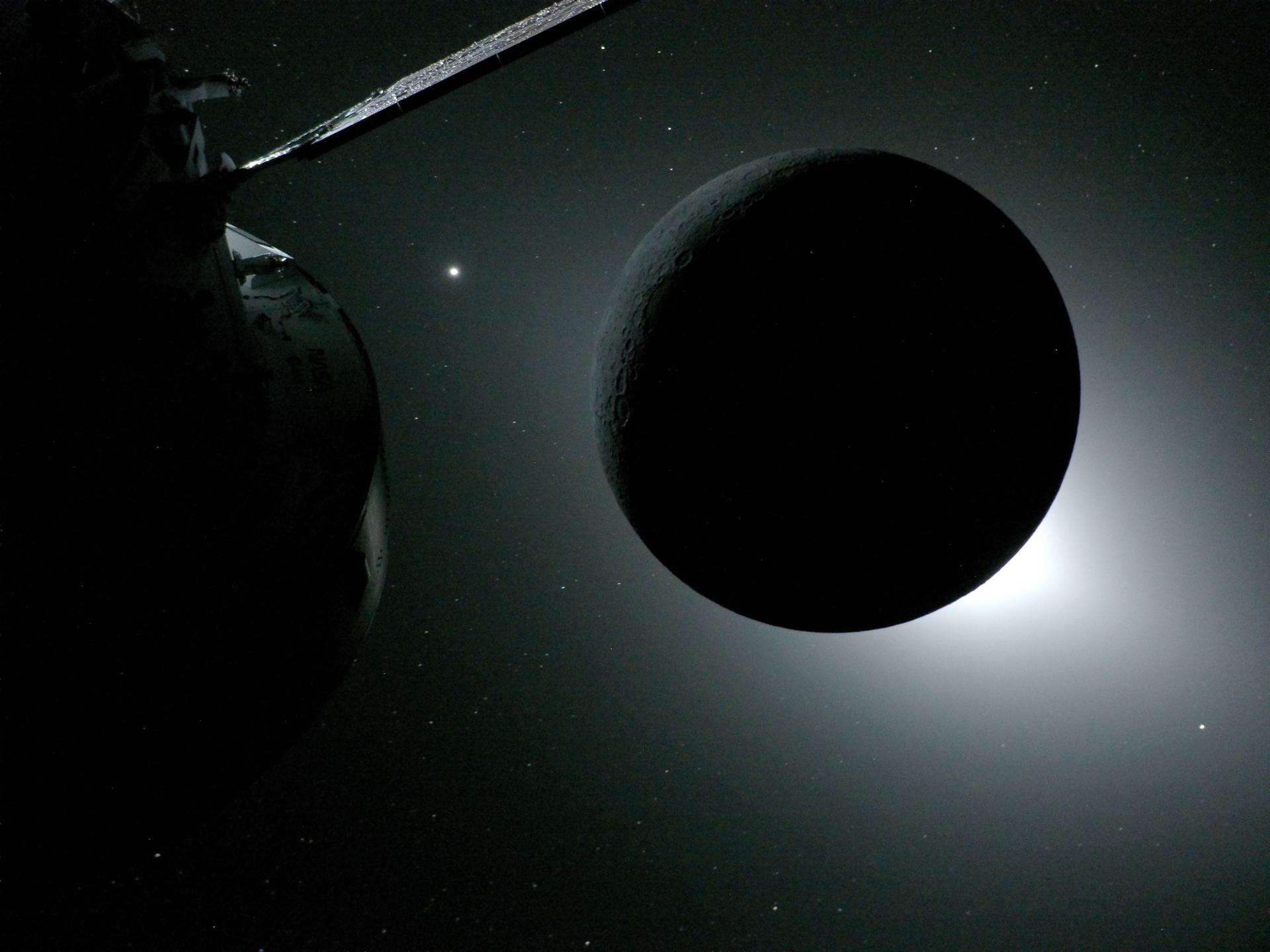
Orion and the Eclipse
art002e016318 (April 6, 2026) - The solar eclipse captured from a camera mounted on one of the Orion spacecraft’s solar array wings during the Artemis II crew’s flyby of the Moon’s far side. The science community is investigating whether the glow around the Moon is from zodiacal light -- interstellar dust that’s reflecting sunlight -- the solar corona, or a combination of the two. Unlike minutes-long eclipses as viewed from Earth, the Artemis II crew saw the Sun hide behind the Moon for nearly an hour. In this image, Venus can be spotted on the left, and Saturn on the right of the Moon.
Far Side of the Moon
The far side was first seen directly by human eyes during the Apollo 8 mission in December, 1968. Astronaut William Anders described the view:
"The backside looks like a sand pile my kids have played in for some time. It's all beat up, no definition, just a lot of bumps and holes."
Apollo 8 (December 21–27, 1968) was the first crewed spacecraft to leave Earth's gravitational sphere of influence, and the first human spaceflight to reach the Moon. The crew orbited the Moon ten times without landing and then returned to Earth. The three astronauts -- Frank Borman, Jim Lovell, and William Anders -- were the first humans to see and photograph the far side of the Moon and an Earthrise.
Apollo 17 (December 7–19, 1972) was the eleventh and final crewed mission of NASA's Apollo program, the sixth and most recent time humans have set foot on the Moon. Commander Gene Cernan and Lunar Module Pilot Harrison Schmitt walked on the Moon, while Command Module Pilot Ronald Evans orbited above. Schmitt was the only professional geologist to land on the Moon; he was selected in place of Joe Engle, as NASA had been under pressure to send a scientist to the Moon. The mission's heavy emphasis on science meant the inclusion of a number of new experiments, including a biological experiment containing five mice that was carried in the command and service module.
crowdfunding Creative Jam. It was inspired by a prompt from siliconshaman. It also fills the "wait" square in my 5-1-26 card for the Greek Myth Fest bingo. This poem belongs to the Blueshift Troupers series."A Spark in the Dark"
[December 21-27, 1968]
Apollo 8 became the first
crewed spacecraft to leave
Earth's gravitational sphere
of influence, with the first
humans to orbit the Moon.
Its three astronauts --
Frank Borman, Jim Lovell,
and William Anders -- thus
became the first humans
to take photographs of
the far side of the Moon.
"What the -- what was
that?" William blurted.
"What did you see?"
Frank said. "Could
it be trouble, or not?"
"I -- I don't know,"
said William. "It
just looked like
a spark in the dark."
"A spark on the Moon?"
said Jim. "On the far side
of the Moon, at that?"
"I know it sounds nuts,
but I saw it," said William.
"Only for a second, though."
"Everyone keep watch
for that," said Frank.
So they kept watch,
and each of them
managed to see it
at least once.
"I think that thing
is blinking," said Jim,
"or maybe flashing."
"I just hope we caught
at least one picture of it,
or nobody will believe us."
They had to wait for landing
and then developing the film
in order to get confirmation
that four photographs of
the far side of the Moon
showed the mysterious light.
It turned the news into a riot
of speculation about whether
the Russians had managed
to drop something up there.
When asked his opinion,
Frank just replied, "Well,
I guess we'll have to go
back up there to check."
[December 7-19, 1972]
Despite the interest, it still
took four years to place
an actual landing craft
on the far side of the Moon.
Other missions explored
the side facing Earth,
which was much safer.
While orbiting, everyone
watched for the odd spark
on the surface of the far side.
Most of those astronauts
spotted it at least once.
They had a hard time
pinning it down, though.
Harrison Schmitt eventually
badgered NASA into revisiting
the far site with a lander.
The geologist-astronaut
managed to pinpoint
the light's location and
the lander set down
not far from there.
What the crew found
was a simple square plate
with a large light on it face.
It seemed to be attached
to the lunar surface, and
they could not budge it at all.
There was no visible source
of power for the device.
"I'm just going to say it,"
Harrison declared. "There
is no way the Russians
could have built this."
Commander Gene Cernan
looked at him. "You think
aliens put a light on the Moon."
"I can't think of any other
explanation," said Harrison.
"Once you've eliminated
the impossible ... well,
there you have it."
That mysterious light
spurred humanity
to further explorations
in search of the builders.
Eventually, they found
something that proved
even more amazing.
* * *
Notes:
This was our original inspiration:
Orion and the Eclipse
art002e016318 (April 6, 2026) - The solar eclipse captured from a camera mounted on one of the Orion spacecraft’s solar array wings during the Artemis II crew’s flyby of the Moon’s far side. The science community is investigating whether the glow around the Moon is from zodiacal light -- interstellar dust that’s reflecting sunlight -- the solar corona, or a combination of the two. Unlike minutes-long eclipses as viewed from Earth, the Artemis II crew saw the Sun hide behind the Moon for nearly an hour. In this image, Venus can be spotted on the left, and Saturn on the right of the Moon.
Far Side of the Moon
The far side was first seen directly by human eyes during the Apollo 8 mission in December, 1968. Astronaut William Anders described the view:
"The backside looks like a sand pile my kids have played in for some time. It's all beat up, no definition, just a lot of bumps and holes."
Apollo 8 (December 21–27, 1968) was the first crewed spacecraft to leave Earth's gravitational sphere of influence, and the first human spaceflight to reach the Moon. The crew orbited the Moon ten times without landing and then returned to Earth. The three astronauts -- Frank Borman, Jim Lovell, and William Anders -- were the first humans to see and photograph the far side of the Moon and an Earthrise.
Apollo 17 (December 7–19, 1972) was the eleventh and final crewed mission of NASA's Apollo program, the sixth and most recent time humans have set foot on the Moon. Commander Gene Cernan and Lunar Module Pilot Harrison Schmitt walked on the Moon, while Command Module Pilot Ronald Evans orbited above. Schmitt was the only professional geologist to land on the Moon; he was selected in place of Joe Engle, as NASA had been under pressure to send a scientist to the Moon. The mission's heavy emphasis on science meant the inclusion of a number of new experiments, including a biological experiment containing five mice that was carried in the command and service module.

(no subject)
Date: 2026-05-18 11:24 pm (UTC)(I never thought I'd use THIS meme again!)
(It just occurred to me he's both a Russian and an alien.)
Looking forward to something even more amazing!
*laugh*
Date: 2026-05-19 12:41 am (UTC)