Poem: "Happy Instruments of Salvation"
Dec. 23rd, 2025 10:45 pm![[personal profile]](https://www.dreamwidth.org/img/silk/identity/user.png) ysabetwordsmith
ysabetwordsmithThis poem is spillover from the July 1, 2025 Poetry Fishbowl. It was inspired by prompts from gothfvck and see_also_friend. It also fills the "Resist Oppression" square in my 7-1-25 card for the Western Bingo fest. This poem has been sponsored by a pool with fuzzyred. It belongs to the series Peculiar Obligations.
"Happy Instruments of Salvation"
[1670s]
Amity Davenport was a good Puritan,
or at least he tried his best to be one.
He went to church faithfully, and he
served God, but the older he got,
the more problems he saw there.
Amity watched poor families put
their last penny in the charity dish,
while rich people with lace dripping
from their cuffs kept their purses
closed or only gave a little bit.
He saw people mouth prayers
on Sunday, then sin on Monday.
When he caught the minister
with a girl of ill repute, he
couldn't tolerate it any more.
So Amity went to seminary
and became a minister.
It wasn't too difficult to get
a church of his own, since
he was willing to work on
the fringes of civilization
where comforts were few.
He never had cared for
the fripperies anyway.
Amity proved popular
as a minister among
folks who just wanted
to live a moral life and
not fuss over politics,
even Church politics.
He followed the rules
to the letter -- and
not one bit farther.
It was amazing what
you could do while
obeying rules exactly.
Amity got the charity
sorted out by telling
folks they could donate
coins if they had any --
or food, or scrap cloth
for quilting, or whatever
other useful bits they had.
He encouraged people
to stick together in groups,
which discouraged mischief.
Now and again, someone
higher up challenged him.
Amity just quoted the part
about a minister being
in charge of his church.
If they persisted, he would
look at them and ask, "Well,
do you have anyone else
willing to take over a church
this far from the big cities?"
No, they did not, and
so Amity stayed there.
He encouraged people
to think about things,
especially before acting.
Some of them turned
critical thinking into
criticism of the Church,
and a few of them even
drifted away from it.
Amity wasn't too upset
by that turn of events.
God wouldn't have given
them intelligence if He
didn't want them to use it.
When other members of
his congregation complained,
Amity just smiled and said,
"Wisdom and knowledge are
happy instruments of salvation
when they are guided by truth."
[1680s]
Eventually, despite following
the rules precisely, this trickle
of exodus built up enough
for the senior clergy to find
someone they disliked enough
to put in charge of Amity's church.
Somewhat at loose ends, he
drifted about until he found
a farmhouse on the outskirts
of town that appealed to him.
He wasn't a farmer, as such,
but it was a small homestead
and he could manage that --
a herd of sheep, a herd of goats,
a horse for travel, a cow for milk,
some chickens, and a garden.
Living in the area were Quakers,
and Amity liked how sensible
they were, so he joined them.
Some of the Quakers had
solid, rational arguments
against the owning of slaves,
and Amity found them plausible.
He had never owned another person
himself, and had no difficulty with
setting himself staunchly against it.
He found his way into the loose network
known as the Underground Railroad.
Escaped slaves fleeing north would
benefit from guidance, supplies, and
shelter from allies along the way.
Amity would drape quilts over
the fence -- a star pattern on
the north fence to show the way
and that he would help, as well as
a basket pattern on the barn fence
to show that food was available.
He always kept the grain bins full,
since people could eat oats as well
as the livestock could. He put tins
of hardtack and jerky on a shelf
to use as traveling food too.
He did not actually know
how many people he
helped in their escape.
He did not want to know;
it was safer that way.
Amity made a point of
never watching them
come or go, and he only
talked with the Quakers
or a few of the freewomen.
The slavecatchers suspected
him anyway, and whenever
they passed through town
hunting some hapless soul,
they badgered him about it.
"Have you seen any runaways?"
demanded one scarred hunter.
"Have you spoken to them?"
"I have neither seen nor
spoken to any runaways,"
Amity said truthfully.
[1690s]
One warm spring day
when Amity went out
to do his barn chores,
he saw that the railing
no longer held the quilt
with the north star pattern.
Instead it held one with
little sailing ships on it.
"What in the world?"
Amity wondered as he
ran a hand along it.
"It's a fine day for
sailin,' but it's not
so fine for farmin',"
a voice said from
around the corner.
"Folks been sniffin'
around a bit too much."
Amity recognized the voice
of a local freewoman, and
appreciated the warning.
"It might be nice to try
sailing," he mused. "I've
always wanted to visit
the sea someday."
"South," she said.
"There are Friends
down there, and also
captains willing to take
passengers who are ...
flying the right flag."
So Amity picked up
the Smooth Sailing quilt
and folded it over his arm.
He hurried back to the house
and quickly packed a few things.
He didn't need much; he never had.
The little homestead could go to
another Friend, and he would
see where the sails took him.
Amity made his way south
until he reached a port, where
he walked around with his things
bundled into the sail quilt.
He asked about travel options,
but nothing came of it for an hour.
Then a black man with a parrot on
the shoulder of his blue coat said,
"Looking for a ride, passenger?
My ship offers smooth sailing."
"I'm hoping to settle somewhere
that does not allow slavery,"
Amity explained to him.
"Free bird, free bird!"
squawked the parrot.
The captain grinned.
"There are a number of
free pirate islands now,
such as the Caymans and
Bermuda," he said. "We're
going past Bermuda and
can drop you off there."
"That sounds good,"
Amity agreed, and
then boarded the ship.
It was a lovely vessel, but
not particularly large, so
he had to cram himself and
his baggage into a tiny cabin
barely bigger than a closet.
That was better than sleeping
in the barracks with the crew,
though -- passengers and
officers got a bit of privacy.
Bermuda turned out to be
a beautiful island, and it was
full of people in all colors and
shapes and styles walking about.
Wedged in between a bank and
a brothel, Amity spotted a star
that marked a Quaker place.
Looking closer, he realized
that it was a hostel. That
would do for a place to stay
until he figured out what
he wanted to do next.
The situation might be
awkward, but Amity was
content with where truth
and wisdom had brought him.
It offered whole new ways
to resist oppression.
* * *
Notes:
Amity Davenport -- originally a Puritan, he became a minister, then later converted to the Quaker faith instead.
* * *
"Wisdom and knowledge are happy instruments of salvation when they are guided by truth."
-- Edward Corbet, William Pemble, William Gouge, The Puritans on the Providence of God, (Crossville, TN: Puritan Publications, 2025) 47.
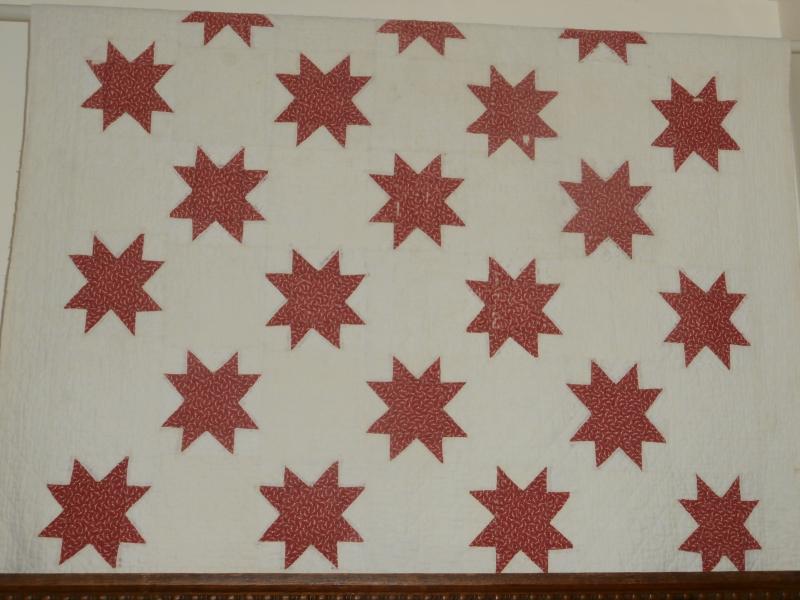
North Star (Evening Star/Star)
This instructed the slaves to follow the North Star to Canada and to freedom.
Quilt North Star
This quilt is the Quaker Star / North Star pattern of an 8-pointed star made with squares and triangles in a 4x4 block. The background of this quilt is muslin from an old sheet, while the stars are made from scraps of reddish-brown calico.
Shoofly: This was a symbol that identified a person who could guide slaves and help them escape along the Underground Railroad.
Row 3 middle right: Basket: “Stay put. Someone will bring you food”.
Quilt Basket
The Basket quilt pattern is made primarily from triangles, plus a trapezoid base and U-shaped handle. This quilt has a muslin background made from an old sheet. The basket pieces are cut from various shades of solid or printed brown fabric.
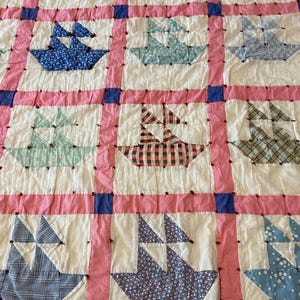
Quilt Smooth Sailing
The Smooth Sailing quilt pattern is made from squares and triangles. Each block is 4x4 squares. The cream background is muslin cut down from old sheets or shirts. The printed fabric for the ships is made from scraps of gingham or calico. The solid pink and blue frame pieces are plain cotton. The quilt is tied with string at the corners of the squares, a less time-consuming method of quilting after the front has been assembled. The back is plain muslin from an old sheet.
gothfvck and see_also_friend. It also fills the "Resist Oppression" square in my 7-1-25 card for the Western Bingo fest. This poem has been sponsored by a pool with fuzzyred. It belongs to the series Peculiar Obligations."Happy Instruments of Salvation"
[1670s]
Amity Davenport was a good Puritan,
or at least he tried his best to be one.
He went to church faithfully, and he
served God, but the older he got,
the more problems he saw there.
Amity watched poor families put
their last penny in the charity dish,
while rich people with lace dripping
from their cuffs kept their purses
closed or only gave a little bit.
He saw people mouth prayers
on Sunday, then sin on Monday.
When he caught the minister
with a girl of ill repute, he
couldn't tolerate it any more.
So Amity went to seminary
and became a minister.
It wasn't too difficult to get
a church of his own, since
he was willing to work on
the fringes of civilization
where comforts were few.
He never had cared for
the fripperies anyway.
Amity proved popular
as a minister among
folks who just wanted
to live a moral life and
not fuss over politics,
even Church politics.
He followed the rules
to the letter -- and
not one bit farther.
It was amazing what
you could do while
obeying rules exactly.
Amity got the charity
sorted out by telling
folks they could donate
coins if they had any --
or food, or scrap cloth
for quilting, or whatever
other useful bits they had.
He encouraged people
to stick together in groups,
which discouraged mischief.
Now and again, someone
higher up challenged him.
Amity just quoted the part
about a minister being
in charge of his church.
If they persisted, he would
look at them and ask, "Well,
do you have anyone else
willing to take over a church
this far from the big cities?"
No, they did not, and
so Amity stayed there.
He encouraged people
to think about things,
especially before acting.
Some of them turned
critical thinking into
criticism of the Church,
and a few of them even
drifted away from it.
Amity wasn't too upset
by that turn of events.
God wouldn't have given
them intelligence if He
didn't want them to use it.
When other members of
his congregation complained,
Amity just smiled and said,
"Wisdom and knowledge are
happy instruments of salvation
when they are guided by truth."
[1680s]
Eventually, despite following
the rules precisely, this trickle
of exodus built up enough
for the senior clergy to find
someone they disliked enough
to put in charge of Amity's church.
Somewhat at loose ends, he
drifted about until he found
a farmhouse on the outskirts
of town that appealed to him.
He wasn't a farmer, as such,
but it was a small homestead
and he could manage that --
a herd of sheep, a herd of goats,
a horse for travel, a cow for milk,
some chickens, and a garden.
Living in the area were Quakers,
and Amity liked how sensible
they were, so he joined them.
Some of the Quakers had
solid, rational arguments
against the owning of slaves,
and Amity found them plausible.
He had never owned another person
himself, and had no difficulty with
setting himself staunchly against it.
He found his way into the loose network
known as the Underground Railroad.
Escaped slaves fleeing north would
benefit from guidance, supplies, and
shelter from allies along the way.
Amity would drape quilts over
the fence -- a star pattern on
the north fence to show the way
and that he would help, as well as
a basket pattern on the barn fence
to show that food was available.
He always kept the grain bins full,
since people could eat oats as well
as the livestock could. He put tins
of hardtack and jerky on a shelf
to use as traveling food too.
He did not actually know
how many people he
helped in their escape.
He did not want to know;
it was safer that way.
Amity made a point of
never watching them
come or go, and he only
talked with the Quakers
or a few of the freewomen.
The slavecatchers suspected
him anyway, and whenever
they passed through town
hunting some hapless soul,
they badgered him about it.
"Have you seen any runaways?"
demanded one scarred hunter.
"Have you spoken to them?"
"I have neither seen nor
spoken to any runaways,"
Amity said truthfully.
[1690s]
One warm spring day
when Amity went out
to do his barn chores,
he saw that the railing
no longer held the quilt
with the north star pattern.
Instead it held one with
little sailing ships on it.
"What in the world?"
Amity wondered as he
ran a hand along it.
"It's a fine day for
sailin,' but it's not
so fine for farmin',"
a voice said from
around the corner.
"Folks been sniffin'
around a bit too much."
Amity recognized the voice
of a local freewoman, and
appreciated the warning.
"It might be nice to try
sailing," he mused. "I've
always wanted to visit
the sea someday."
"South," she said.
"There are Friends
down there, and also
captains willing to take
passengers who are ...
flying the right flag."
So Amity picked up
the Smooth Sailing quilt
and folded it over his arm.
He hurried back to the house
and quickly packed a few things.
He didn't need much; he never had.
The little homestead could go to
another Friend, and he would
see where the sails took him.
Amity made his way south
until he reached a port, where
he walked around with his things
bundled into the sail quilt.
He asked about travel options,
but nothing came of it for an hour.
Then a black man with a parrot on
the shoulder of his blue coat said,
"Looking for a ride, passenger?
My ship offers smooth sailing."
"I'm hoping to settle somewhere
that does not allow slavery,"
Amity explained to him.
"Free bird, free bird!"
squawked the parrot.
The captain grinned.
"There are a number of
free pirate islands now,
such as the Caymans and
Bermuda," he said. "We're
going past Bermuda and
can drop you off there."
"That sounds good,"
Amity agreed, and
then boarded the ship.
It was a lovely vessel, but
not particularly large, so
he had to cram himself and
his baggage into a tiny cabin
barely bigger than a closet.
That was better than sleeping
in the barracks with the crew,
though -- passengers and
officers got a bit of privacy.
Bermuda turned out to be
a beautiful island, and it was
full of people in all colors and
shapes and styles walking about.
Wedged in between a bank and
a brothel, Amity spotted a star
that marked a Quaker place.
Looking closer, he realized
that it was a hostel. That
would do for a place to stay
until he figured out what
he wanted to do next.
The situation might be
awkward, but Amity was
content with where truth
and wisdom had brought him.
It offered whole new ways
to resist oppression.
* * *
Notes:
Amity Davenport -- originally a Puritan, he became a minister, then later converted to the Quaker faith instead.
* * *
"Wisdom and knowledge are happy instruments of salvation when they are guided by truth."
-- Edward Corbet, William Pemble, William Gouge, The Puritans on the Providence of God, (Crossville, TN: Puritan Publications, 2025) 47.
North Star (Evening Star/Star)
This instructed the slaves to follow the North Star to Canada and to freedom.
Quilt North Star
This quilt is the Quaker Star / North Star pattern of an 8-pointed star made with squares and triangles in a 4x4 block. The background of this quilt is muslin from an old sheet, while the stars are made from scraps of reddish-brown calico.
Shoofly: This was a symbol that identified a person who could guide slaves and help them escape along the Underground Railroad.
Row 3 middle right: Basket: “Stay put. Someone will bring you food”.
Quilt Basket
The Basket quilt pattern is made primarily from triangles, plus a trapezoid base and U-shaped handle. This quilt has a muslin background made from an old sheet. The basket pieces are cut from various shades of solid or printed brown fabric.
Quilt Smooth Sailing
The Smooth Sailing quilt pattern is made from squares and triangles. Each block is 4x4 squares. The cream background is muslin cut down from old sheets or shirts. The printed fabric for the ships is made from scraps of gingham or calico. The solid pink and blue frame pieces are plain cotton. The quilt is tied with string at the corners of the squares, a less time-consuming method of quilting after the front has been assembled. The back is plain muslin from an old sheet.