Notes for "Garden Bread"
Aug. 19th, 2021 08:01 pm![[personal profile]](https://www.dreamwidth.org/img/silk/identity/user.png) ysabetwordsmith
ysabetwordsmithThese are the notes for "Garden Bread."
Adam Garner -- He has sorrel skin, brown eyes, and short nappy black hair. He is tall with wiry muscles. He is homoromantic homosexual. He speaks English and French. He is 28 years old in 2015.
Adam earned a Bachelor of Science in Culinology with a minor in Gender and Sexuality Studies at the Southwest Minnesota State University in Marshall. He belonged to the African Student Association, Culinology Club, LGBTQA+ Club, and Research Chefs Association. Later he joined LuMin, an open Lutheran organization aimed at promoting fellowship among all people. Through the Culinology program, Adam met Steve; they fell in love and got married after graduating. Eventually they launched a slow food show on television, Adam and Steve in the Garden of Eden. It focuses primarily on fresh, whole foods and enjoying activities in the kitchen; while not vegetarian or vegan, it does emphasize plant foods over animal foods.
Adam is a good Christian, but he only associates with people who are open-minded enough that they don't mind him being black and gay. He's a bigot magnet and doesn't need that mucking up his spiritual life. He and Steve often volunteer at the local Lutheran church, and are popular in that congregation.
Qualities: Good (+2) Christian, Good (+2) Culinology, Good (+2) Dexterity, Good (+2) Gender and Sexuality Studies, Good (+2) Naturalistic Intelligence
Poor (-2) Bigot Magnet
Bachelor of Science in Culinology
at the Southwest Minnesota State University in Marshall
Bachelor of Science: Culinology®
I. Math and Science Courses: (13 Credits)
• > BIOL 303 Microbiology Credits: 3
• > BIOL 377 Principles of Nutrition Credits: 3
• > CHEM 122 Introductory Organic/Biochemistry Credits: 3
• > CHEM 122L Introduction to Organic/Biochemistry Lab Credits: 1
• > MATH 200 Intro to Statistics Credits: 3
Adam did his first internship with the Minnesota Nutrition program, and his second with the Soul Food Collective.
II. Culinology® Core Courses (41-45 Credits)
• > ACCT 211 Principles of Accounting I Credits: 3
• > CULG 100 Introduction to Culinology Credits: 1
• > CULG 200 Culinary Arts Fundamentals Credits: 4
• > CULG 210 Advanced Culinary Arts Credits: 4
• > CULG 310 Introduction to Food Science Credits: 3
• > CULG 360 Food Sensory Analysis Credits: 3
• > CULG 390 Food Products Development I Credits: 3
• > CULG 410 Food Chemistry and Analysis Credits: 3
• > CULG 430 Unit Operations in Food Processing Credits: 3
• > CULG 440 Food Legislation and Regulation Credits: 3
• > CULG 450 Technical & Functional Ingredients in Food Credits: 3
• > CULG 480 Food Quality and Safety Credits: 3
• > CULG 490 Food Product Development II Credits: 3
• > CULG 498 Internship Credits: 1 - 9
• > CULG 499 Internship Credits: 1 - 9
III. Hospitality Courses: (9 Credits)
• > HOSP 120 Food Sanitation and Safety Credits: 1
• > HOSP 205 Hospitality Purchasing Credits: 3
• > HOSP 301 Restaurant Food Operations Credits: 2
• > HOSP 301L Restaurant Food Operations Lab Credits: 3
IV. Choose one course from the following: (3 Credits)
• > CULG 250 Introduction to Baking & Pastry Credits: 3
Credits: 3
Total Credits for Bachelor of Science: Culinology®: 66-70
T-America offers a Gender and Sexuality Studies variation, which uses LIT 340 instead of LIT 375 and PHIL 310 instead of PSYCH 250.
Minor in Women's Studies
at the Southwest Minnesota State University in Marshall
The goal of the Women’s Studies minor is to enrich students’ understanding of women’s roles and the influence of gender in society by examining these subjects through a variety of perspectives and disciplines. The strength of the minor lies in a multidisciplinary framework that enables students to make connections and draw comparisons both within the United States and globally. Course descriptions are listed under each discipline.
Minor: Women's Studies
Core Courses: (12 Credits)
• > HIST 360 American Women's History Credits: 3
• > LIT 375 Women's Literature Credits: 3
• > PSYC 250 Psychology of Women Credits: 3
• > SOCI 270 Gender Issues Credits: 3
Electives: (9 Credits)
• > ART 208 Artists Course Credits: 1
• > LIT 340 Sexuality and Gender in Literature Credits: 3
• > MGMT 450 Diversity Management Credits: 3
• > PHIL 310 The Philosophy of Sex and Gender Credits: 3
• > SOCI 324 Sociology of Sexualities Credits: 3
• Footnotes:
Additional approved courses vary each semester. See course schedule under "Women's Studies" for approved electives or contact the Women's Studies Coordinator.
Minor: Women's Studies Notes:
At least four of the seven courses must be taken at Southwest Minnesota State University.
Total Credits for Minor: Women's Studies: 21
Steve Garner -- He has fair skin, brown eyes, and black hair. His hair is buzzed short on top, and receding, but he has a dense beard also buzzed short. He is slim and petite, with a flexible body. He is homoromantic homosexual. He speaks English and French. He is 28 years old in 2015.
Steve earned a Bachelor of Arts in Art with a double minor in Filmmaking and Nutrition at the Southwest Minnesota State University in Marshall. He belonged to the Broadcast Education Association and the Theatre Program's Drama Club. He also participated in the Culinology Club and the LGBTQA+ Club. Later he joined LuMin, an open Lutheran organization aimed at promoting fellowship among all people. Through the Culinology program, Steve met Adam; they fell in love and got married after graduating. Eventually they launched a slow food show on television, Adam and Steve in the Garden of Eden. It focuses primarily on fresh, whole foods and enjoying activities in the kitchen; while not vegetarian or vegan, it does emphasize plant foods over animal foods.
Steve is only a casual Christian, but he is willing to tag along with Adam, who is more devout. They only associate with people who are open-minded enough to handle an interracial gay couple. Adam and Steve often volunteer at the local Lutheran church, and are popular in that congregation.
Qualities: Good (+2) Artist, Good (+2) Filmmaker, Good (+2) Flexible, Good (+2) Nutrition, Good (+2) Visual-Spatial Intelligence
Poor (-2) Short Guy Problems
Bachelor of Arts: Art
at the Southwest Minnesota State University in Marshall
I. Foundation Requirements:
Studio Core: (21 Credits)
• > ART 102 Foundations of Art & Design 2D Credits: 3
• > ART 103 Foundations of Art and Design 3D Credits: 3
• > ART 220 Drawing Credits: 4
• > ART 221 Painting Credits: 4
• > ART 230 Sculpture Credits: 4
• > ART 242 Digital Art Credits: 3
Art History: (6 Credits)
• > ART 150 Art History I Credits: 3
• > ART 151 Art History II Credits: 3
Interdisciplinary: (3 Credits)
• > PHIL 201 Aesthetics Credits: 3
Review Courses: (1 Credits)
• > ART 260 Sophomore Review Credits: 0
• > ART 360 Junior Review Credits: 1
II. Emphasis Courses (Choose Option 1 or Option 2):
Option 1: Studio Art (23 Credits)
Art History Electives: (3 Credits)
• > ART 353 Queer Art Credits: 3 (T-American)
Studio Electives: (16 Credits)
• > ART 320 Drawing Credits: 4
• > ART 326 Figure Drawing Credits: 4
• > ART 330 Sculpture Credits: 4
• > ART 331 Ceramics Credits: 4
Capstone Experience: (4 Credits)
• Notes:
The studio course in the major emphasis area is taken concurrently with ART 460 for the Capstone Experience.
• > ART 3XX Studio Course in Major Emphasis Area Credits: 4
• > ART 460 Graduation Exhibition: Senior Review Credits: 0
Total Credits for Bachelor of Arts: Art: 58
Minor in Filmmaking
at the Southwest Minnesota State University in Marshall
2021-2022 Catalog » Communication Studies
Minor: Filmmaking
Required Courses: (18 Credits)
• > COMM 114 Essentials of Single Camera Field Production Credits: 3
• > COMM 232 The Art of Making Films Credits: 3
• > COMM 350 Narrative Filmmaking Credits: 3
• > COMM 480 Creative Project Workshop in Media Production Credits: 3
• > ENG 303 Screenwriting Workshop Credits: 3
• > THTR 341 Acting for the Camera I Credits: 3
Filmmaking Electives: (3 Credits)
• > COMM 112 Multicamera Television Production Credits: 3
Total Credits for Minor: Filmmaking: 22
Minor in Nutrition
at the Southwest Minnesota State University in Marshall
I. Prerequisite Courses: (12 Credits)
• > BIOL 200 Introduction to Cellular Biology Credits: 3
• > BIOL 200L Introduction to Cellular Biology Lab Credits: 1
• > CHEM 122 Introductory Organic/Biochemistry Credits: 3
• > CHEM 122L Introduction to Organic/Biochemistry Lab Credits: 1
Choose one course with lab:
• > CHEM 121 Basic Chemistry Credits: 3
• > CHEM 121L Basic Chemistry Lab Credits: 1
II. Required Courses: (14 Credits)
• > BIOL 377 Principles of Nutrition Credits: 3
• > CULG 310 Introduction to Food Science Credits: 3
• > CULG 410 Food Chemistry and Analysis Credits: 3
• > EXSC 225 Nutrition Credits: 3
• > EXSC 325 Nutrition & Exercise Credits: 2
Total Credits for Minor: Nutrition: 26
https://www.smsu.edu/catalog/index.html?catalogYear=80&categoryId=999
* * *
Adam and Steve in the Garden of Eden is a Terramagne-American slow food cooking show that promotes fresh fruits and vegetables. Each episode has three segments. The first shows Adam and Steve, a gay couple, cooking something spectacular. The second brings in novice cooks while Adam and Steve teach a kitchen technique. In the final segment, the novices are challenged to gather ingredients from a garden-like setting and create a great dish using the technique they just learned.
(premiers in 2015)
Bigots have used assorted variations of "God made Adam and Eve, not Adam and Steve." I also found this hilariously precise argument that the first humans in the Garden of Eden were both male, or perhaps, were identical neuter clones, with heterosexuality added only after the Fall and consequent need for reproduction.
Slow Food is a movement based on cooking healthy food from scratch, preferably in a social context. Learn how to get started in Slow Food.
(Warning for horrifying kitchen mistakes.)
Cooking shows can have serious hazards. One thing I hate about local-American competition shows, especially cooking shows, is the use of time limits. Rushing in a kitchen is a reliable way to get hurt, sometimes seriously. On various shows I've seen people cut themselves, burn themselves, slip and fall -- all because they broke literally the first rule everyone learns in cooking, "Be careful because kitchens are full of sharp and hot things." And they did that because someone important told them to and rewarded them for misbehaving, which is dangerously irresponsible on the part of the people in charge.
There are many recipes for focaccia bread, which vary dramatically by time and somewhat by ingredients or other features, so browse around before choosing what suits your needs. This basic recipe for Garden Focaccia takes about 2 1/2 hours, while this Easy Garden Focaccia one takes over 13 hours. See also Whole-Wheat Focaccia (8-10 hours), Sourdough Focaccia Floral Art (7+ hours), Gluten-Free Focaccia Bread Art (about 2 hours), and Vegan Focaccia (7 hours 45 minutes). Yes, there are non-vegan versions that use milk (3 1/2 hours), butter (2 hours 45 minutes), bacon and eggs (3 hours), etc. If you want different colors, there is Simon's brown Pumpernickel Focaccia (2 hours 15 minutes), Tolli's golden Turmeric-Rosemary No-Knead Focaccia Bread (14 hours 15 minutes), or Shiv's pinkish Beet Focaccia (16+ hours). Beet focaccia can turn out anywhere from a coppery pink to a fairly bright purple.
Why the colors? Simon, following the garden them, may have been thinking about soil colors. Shiv, the artist, was probably thinking about skin tones. Notice that these two palettes cover most of the same colors. Bread is often used to make human figures, and this recipe shows how to cut a blob of dough to shape it. So if you had several focaccia recipes using different ingredients, you could easily make a basket of multicultural bread people.
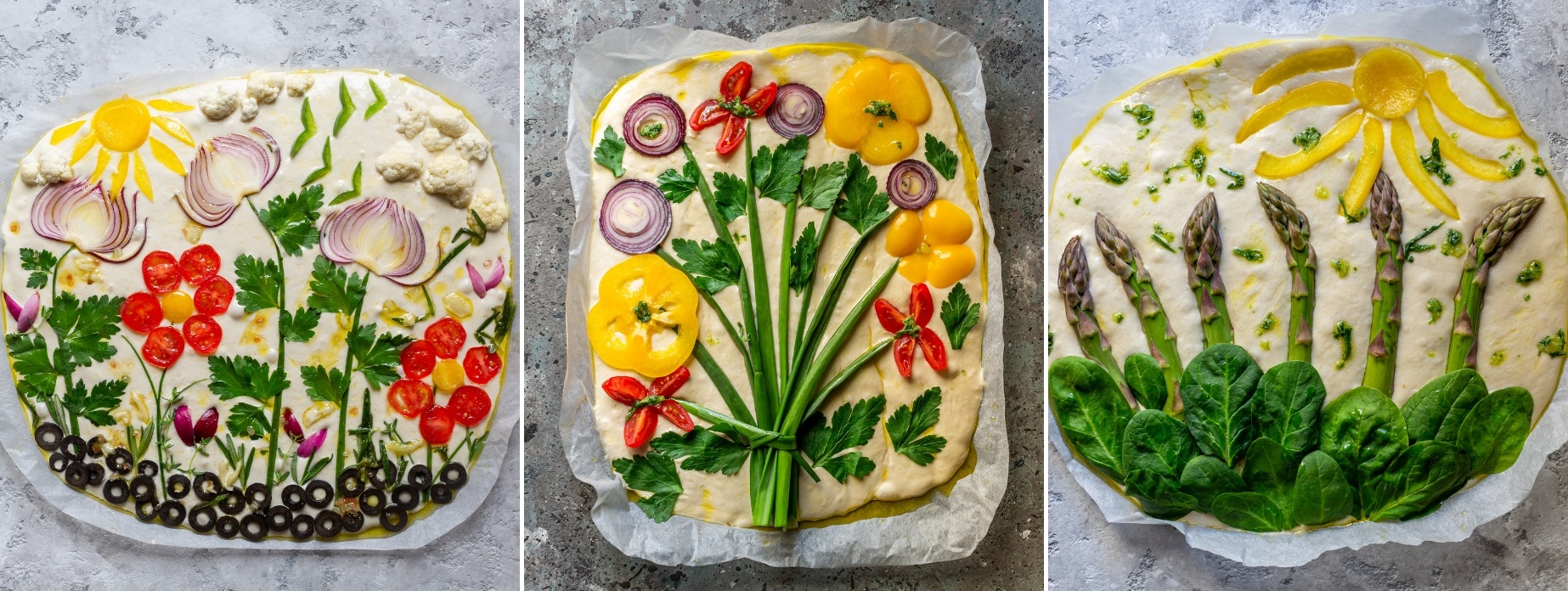
Garden Bread is a nickname for loaves that use cut produce to make a scene of flowers on top. Despite people calling it a modern fad, this technique is thousands of years old -- not much younger than bread itself -- as bakers have long used toppings for flavor, to distinguish different types of bread, and to make artistic designs or pictures. Compare pictures of raw and baked loaves to show the changes from cooking. Note that some things (tomatoes, peppers) retain most of their vivid colors, others (most herbs and greens) fade dramatically.
Knife skills are essential for cooking, like the basic slice, julienne, dice, and mince. Here are some tutorials in videos, text and videos, and text with pictures.
My advice on knife safety: 1) Use a knife that fits your hand. I use a paring knife for almost everything, because I have tiny hands and a chef knife is way too big for me. 2) Every blade has a proper sharpening angle; use it. Too sharp an edge is as dangerous as too dull, and prone to damage. 3) Use a grip that feels comfortable, on the knife and on what you're cutting. A technically correct grip that feels awkward will make you drop things and/or cut yourself. The talked-up "claw grip" will not save you from carelessness, as your knuckles are just as vulnerable as your fingers. 4) Keep the sharp part of the tools away from the soft parts of yourself and you will be safe. Cut away from yourself as much as possible, and avoid using too much force. 5) Don't hesitate to use adaptive cutters and grippers if you like them to keep your fingers away from the sharp parts. There are all kinds, from spikes to tongs to wraps. Designed for people with disabilities, they also work for keeping anyone's bits attached. 6) Plan for safety. Pay extremely close attention to what you are doing, and never rush in the kitchen.
Some recipes are extremely versatile, good for using whatever ingredients you have:
You can stir-fry almost anything. Enjoy some stir-fry recipes.
Everyday Salad is easy to customize, and here are some more salad recipes. Flower Salad looks more precise until you realize it's basically four categories: salad greens, leafy herbs, edible flower petals, and fruit/vegetable mix-ins. Use whatever you have and like within those categories.
Quick pickles are intended to be made and eaten the same day, with options for cold or hot processing. Here are more recipes for quick pickles.
Pointillism branched off from Impressionism in art. Both use small, distinct bits of color to create a larger composite image. These techniques work extremely well in art bread, as in this replica of "Starry Night."
Adam Garner -- He has sorrel skin, brown eyes, and short nappy black hair. He is tall with wiry muscles. He is homoromantic homosexual. He speaks English and French. He is 28 years old in 2015.
Adam earned a Bachelor of Science in Culinology with a minor in Gender and Sexuality Studies at the Southwest Minnesota State University in Marshall. He belonged to the African Student Association, Culinology Club, LGBTQA+ Club, and Research Chefs Association. Later he joined LuMin, an open Lutheran organization aimed at promoting fellowship among all people. Through the Culinology program, Adam met Steve; they fell in love and got married after graduating. Eventually they launched a slow food show on television, Adam and Steve in the Garden of Eden. It focuses primarily on fresh, whole foods and enjoying activities in the kitchen; while not vegetarian or vegan, it does emphasize plant foods over animal foods.
Adam is a good Christian, but he only associates with people who are open-minded enough that they don't mind him being black and gay. He's a bigot magnet and doesn't need that mucking up his spiritual life. He and Steve often volunteer at the local Lutheran church, and are popular in that congregation.
Qualities: Good (+2) Christian, Good (+2) Culinology, Good (+2) Dexterity, Good (+2) Gender and Sexuality Studies, Good (+2) Naturalistic Intelligence
Poor (-2) Bigot Magnet
Bachelor of Science in Culinology
at the Southwest Minnesota State University in Marshall
Bachelor of Science: Culinology®
I. Math and Science Courses: (13 Credits)
• > BIOL 303 Microbiology Credits: 3
• > BIOL 377 Principles of Nutrition Credits: 3
• > CHEM 122 Introductory Organic/Biochemistry Credits: 3
• > CHEM 122L Introduction to Organic/Biochemistry Lab Credits: 1
• > MATH 200 Intro to Statistics Credits: 3
Adam did his first internship with the Minnesota Nutrition program, and his second with the Soul Food Collective.
II. Culinology® Core Courses (41-45 Credits)
• > ACCT 211 Principles of Accounting I Credits: 3
• > CULG 100 Introduction to Culinology Credits: 1
• > CULG 200 Culinary Arts Fundamentals Credits: 4
• > CULG 210 Advanced Culinary Arts Credits: 4
• > CULG 310 Introduction to Food Science Credits: 3
• > CULG 360 Food Sensory Analysis Credits: 3
• > CULG 390 Food Products Development I Credits: 3
• > CULG 410 Food Chemistry and Analysis Credits: 3
• > CULG 430 Unit Operations in Food Processing Credits: 3
• > CULG 440 Food Legislation and Regulation Credits: 3
• > CULG 450 Technical & Functional Ingredients in Food Credits: 3
• > CULG 480 Food Quality and Safety Credits: 3
• > CULG 490 Food Product Development II Credits: 3
• > CULG 498 Internship Credits: 1 - 9
• > CULG 499 Internship Credits: 1 - 9
III. Hospitality Courses: (9 Credits)
• > HOSP 120 Food Sanitation and Safety Credits: 1
• > HOSP 205 Hospitality Purchasing Credits: 3
• > HOSP 301 Restaurant Food Operations Credits: 2
• > HOSP 301L Restaurant Food Operations Lab Credits: 3
IV. Choose one course from the following: (3 Credits)
• > CULG 250 Introduction to Baking & Pastry Credits: 3
Credits: 3
Total Credits for Bachelor of Science: Culinology®: 66-70
T-America offers a Gender and Sexuality Studies variation, which uses LIT 340 instead of LIT 375 and PHIL 310 instead of PSYCH 250.
Minor in Women's Studies
at the Southwest Minnesota State University in Marshall
The goal of the Women’s Studies minor is to enrich students’ understanding of women’s roles and the influence of gender in society by examining these subjects through a variety of perspectives and disciplines. The strength of the minor lies in a multidisciplinary framework that enables students to make connections and draw comparisons both within the United States and globally. Course descriptions are listed under each discipline.
Minor: Women's Studies
Core Courses: (12 Credits)
• > HIST 360 American Women's History Credits: 3
• > PSYC 250 Psychology of Women Credits: 3
• > SOCI 270 Gender Issues Credits: 3
Electives: (9 Credits)
• > ART 208 Artists Course Credits: 1
• > LIT 340 Sexuality and Gender in Literature Credits: 3
• > MGMT 450 Diversity Management Credits: 3
• > PHIL 310 The Philosophy of Sex and Gender Credits: 3
• > SOCI 324 Sociology of Sexualities Credits: 3
• Footnotes:
Additional approved courses vary each semester. See course schedule under "Women's Studies" for approved electives or contact the Women's Studies Coordinator.
Minor: Women's Studies Notes:
At least four of the seven courses must be taken at Southwest Minnesota State University.
Total Credits for Minor: Women's Studies: 21
Steve Garner -- He has fair skin, brown eyes, and black hair. His hair is buzzed short on top, and receding, but he has a dense beard also buzzed short. He is slim and petite, with a flexible body. He is homoromantic homosexual. He speaks English and French. He is 28 years old in 2015.
Steve earned a Bachelor of Arts in Art with a double minor in Filmmaking and Nutrition at the Southwest Minnesota State University in Marshall. He belonged to the Broadcast Education Association and the Theatre Program's Drama Club. He also participated in the Culinology Club and the LGBTQA+ Club. Later he joined LuMin, an open Lutheran organization aimed at promoting fellowship among all people. Through the Culinology program, Steve met Adam; they fell in love and got married after graduating. Eventually they launched a slow food show on television, Adam and Steve in the Garden of Eden. It focuses primarily on fresh, whole foods and enjoying activities in the kitchen; while not vegetarian or vegan, it does emphasize plant foods over animal foods.
Steve is only a casual Christian, but he is willing to tag along with Adam, who is more devout. They only associate with people who are open-minded enough to handle an interracial gay couple. Adam and Steve often volunteer at the local Lutheran church, and are popular in that congregation.
Qualities: Good (+2) Artist, Good (+2) Filmmaker, Good (+2) Flexible, Good (+2) Nutrition, Good (+2) Visual-Spatial Intelligence
Poor (-2) Short Guy Problems
Bachelor of Arts: Art
at the Southwest Minnesota State University in Marshall
I. Foundation Requirements:
Studio Core: (21 Credits)
• > ART 102 Foundations of Art & Design 2D Credits: 3
• > ART 103 Foundations of Art and Design 3D Credits: 3
• > ART 220 Drawing Credits: 4
• > ART 221 Painting Credits: 4
• > ART 230 Sculpture Credits: 4
• > ART 242 Digital Art Credits: 3
Art History: (6 Credits)
• > ART 150 Art History I Credits: 3
• > ART 151 Art History II Credits: 3
Interdisciplinary: (3 Credits)
• > PHIL 201 Aesthetics Credits: 3
Review Courses: (1 Credits)
• > ART 260 Sophomore Review Credits: 0
• > ART 360 Junior Review Credits: 1
II. Emphasis Courses (Choose Option 1 or Option 2):
Option 1: Studio Art (23 Credits)
Art History Electives: (3 Credits)
• > ART 353 Queer Art Credits: 3 (T-American)
Studio Electives: (16 Credits)
• > ART 320 Drawing Credits: 4
• > ART 326 Figure Drawing Credits: 4
• > ART 330 Sculpture Credits: 4
• > ART 331 Ceramics Credits: 4
Capstone Experience: (4 Credits)
• Notes:
The studio course in the major emphasis area is taken concurrently with ART 460 for the Capstone Experience.
• > ART 3XX Studio Course in Major Emphasis Area Credits: 4
• > ART 460 Graduation Exhibition: Senior Review Credits: 0
Total Credits for Bachelor of Arts: Art: 58
Minor in Filmmaking
at the Southwest Minnesota State University in Marshall
2021-2022 Catalog » Communication Studies
Minor: Filmmaking
Required Courses: (18 Credits)
• > COMM 114 Essentials of Single Camera Field Production Credits: 3
• > COMM 232 The Art of Making Films Credits: 3
• > COMM 350 Narrative Filmmaking Credits: 3
• > COMM 480 Creative Project Workshop in Media Production Credits: 3
• > ENG 303 Screenwriting Workshop Credits: 3
• > THTR 341 Acting for the Camera I Credits: 3
Filmmaking Electives: (3 Credits)
• > COMM 112 Multicamera Television Production Credits: 3
Total Credits for Minor: Filmmaking: 22
Minor in Nutrition
at the Southwest Minnesota State University in Marshall
I. Prerequisite Courses: (12 Credits)
• > BIOL 200 Introduction to Cellular Biology Credits: 3
• > BIOL 200L Introduction to Cellular Biology Lab Credits: 1
• > CHEM 122 Introductory Organic/Biochemistry Credits: 3
• > CHEM 122L Introduction to Organic/Biochemistry Lab Credits: 1
Choose one course with lab:
• > CHEM 121 Basic Chemistry Credits: 3
• > CHEM 121L Basic Chemistry Lab Credits: 1
II. Required Courses: (14 Credits)
• > BIOL 377 Principles of Nutrition Credits: 3
• > CULG 310 Introduction to Food Science Credits: 3
• > CULG 410 Food Chemistry and Analysis Credits: 3
• > EXSC 225 Nutrition Credits: 3
• > EXSC 325 Nutrition & Exercise Credits: 2
Total Credits for Minor: Nutrition: 26
https://www.smsu.edu/catalog/index.html?catalogYear=80&categoryId=999
* * *
Adam and Steve in the Garden of Eden is a Terramagne-American slow food cooking show that promotes fresh fruits and vegetables. Each episode has three segments. The first shows Adam and Steve, a gay couple, cooking something spectacular. The second brings in novice cooks while Adam and Steve teach a kitchen technique. In the final segment, the novices are challenged to gather ingredients from a garden-like setting and create a great dish using the technique they just learned.
(premiers in 2015)
Bigots have used assorted variations of "God made Adam and Eve, not Adam and Steve." I also found this hilariously precise argument that the first humans in the Garden of Eden were both male, or perhaps, were identical neuter clones, with heterosexuality added only after the Fall and consequent need for reproduction.
Slow Food is a movement based on cooking healthy food from scratch, preferably in a social context. Learn how to get started in Slow Food.
(Warning for horrifying kitchen mistakes.)
Cooking shows can have serious hazards. One thing I hate about local-American competition shows, especially cooking shows, is the use of time limits. Rushing in a kitchen is a reliable way to get hurt, sometimes seriously. On various shows I've seen people cut themselves, burn themselves, slip and fall -- all because they broke literally the first rule everyone learns in cooking, "Be careful because kitchens are full of sharp and hot things." And they did that because someone important told them to and rewarded them for misbehaving, which is dangerously irresponsible on the part of the people in charge.
There are many recipes for focaccia bread, which vary dramatically by time and somewhat by ingredients or other features, so browse around before choosing what suits your needs. This basic recipe for Garden Focaccia takes about 2 1/2 hours, while this Easy Garden Focaccia one takes over 13 hours. See also Whole-Wheat Focaccia (8-10 hours), Sourdough Focaccia Floral Art (7+ hours), Gluten-Free Focaccia Bread Art (about 2 hours), and Vegan Focaccia (7 hours 45 minutes). Yes, there are non-vegan versions that use milk (3 1/2 hours), butter (2 hours 45 minutes), bacon and eggs (3 hours), etc. If you want different colors, there is Simon's brown Pumpernickel Focaccia (2 hours 15 minutes), Tolli's golden Turmeric-Rosemary No-Knead Focaccia Bread (14 hours 15 minutes), or Shiv's pinkish Beet Focaccia (16+ hours). Beet focaccia can turn out anywhere from a coppery pink to a fairly bright purple.
Why the colors? Simon, following the garden them, may have been thinking about soil colors. Shiv, the artist, was probably thinking about skin tones. Notice that these two palettes cover most of the same colors. Bread is often used to make human figures, and this recipe shows how to cut a blob of dough to shape it. So if you had several focaccia recipes using different ingredients, you could easily make a basket of multicultural bread people.
Garden Bread is a nickname for loaves that use cut produce to make a scene of flowers on top. Despite people calling it a modern fad, this technique is thousands of years old -- not much younger than bread itself -- as bakers have long used toppings for flavor, to distinguish different types of bread, and to make artistic designs or pictures. Compare pictures of raw and baked loaves to show the changes from cooking. Note that some things (tomatoes, peppers) retain most of their vivid colors, others (most herbs and greens) fade dramatically.
Knife skills are essential for cooking, like the basic slice, julienne, dice, and mince. Here are some tutorials in videos, text and videos, and text with pictures.
My advice on knife safety: 1) Use a knife that fits your hand. I use a paring knife for almost everything, because I have tiny hands and a chef knife is way too big for me. 2) Every blade has a proper sharpening angle; use it. Too sharp an edge is as dangerous as too dull, and prone to damage. 3) Use a grip that feels comfortable, on the knife and on what you're cutting. A technically correct grip that feels awkward will make you drop things and/or cut yourself. The talked-up "claw grip" will not save you from carelessness, as your knuckles are just as vulnerable as your fingers. 4) Keep the sharp part of the tools away from the soft parts of yourself and you will be safe. Cut away from yourself as much as possible, and avoid using too much force. 5) Don't hesitate to use adaptive cutters and grippers if you like them to keep your fingers away from the sharp parts. There are all kinds, from spikes to tongs to wraps. Designed for people with disabilities, they also work for keeping anyone's bits attached. 6) Plan for safety. Pay extremely close attention to what you are doing, and never rush in the kitchen.
Some recipes are extremely versatile, good for using whatever ingredients you have:
You can stir-fry almost anything. Enjoy some stir-fry recipes.
Everyday Salad is easy to customize, and here are some more salad recipes. Flower Salad looks more precise until you realize it's basically four categories: salad greens, leafy herbs, edible flower petals, and fruit/vegetable mix-ins. Use whatever you have and like within those categories.
Quick pickles are intended to be made and eaten the same day, with options for cold or hot processing. Here are more recipes for quick pickles.
Pointillism branched off from Impressionism in art. Both use small, distinct bits of color to create a larger composite image. These techniques work extremely well in art bread, as in this replica of "Starry Night."




(no subject)
Date: 2021-08-21 03:56 am (UTC)Well ...
Date: 2021-08-21 04:03 am (UTC)Re: Well ...
Date: 2021-08-22 05:24 pm (UTC)